



If you travel directly south and cross the Orange River, you will find the Catholic mission of Pella in Northern Cape, South Africa.Driving into the little village that has grown around the mission is like driving to an oasis, a welcome sight of green and palm trees in the middle of an otherwise arid landscape.
The mission and village are located on the foot of some mountains, and when you are driving down from the main road, you can see the cathedreal in the distance.
Known for its sweet dates, it’s a Roman gothic cathedral and the first Roman Catholic Mission south of Rehoboth up until the Northern Cape.
Named after a Palestinian city that was a refuge for the persecuted, Pella was founded in 1814 by Christian Khoisan.
But hostility from local residents chased away the initial Lutheran mission, which was only to be revived again as a Catholic mission in 1875.
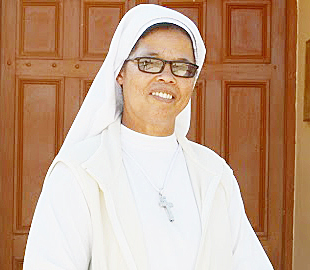
When we first arrive at Pella, we are greeted by two dogs, who Sister Therese Bernadine and Sister Johanna Katrina quickly tell us belong to the church and consider themselves its guardians.
Almost in reply, the dogs quickly chase away some pigeons that rest on the statue of Jesus on the exterior balcony of the church as well as cows and donkeys that get a little too close for comfort.
The two sisters show us around the cathedral and talk of the renovation works that have been done, how long it took to build, and little tid-bits about all the major pieces that were brought into the cathedral. Like the altar that was donated from Europe and a cupboard that was hand carved.
Born and raised in Pella, Sister Johanna Katrina takes on the role of showing us around the church museum and the old bishop’s office.
She takes us through the town to meet local people, and we are introduced to some members of the community who speak Khoekhoegowab and still have family back in Namibia – a welcome find when one is far away from home.
The museum explains more about how the church was built, its history, the different altars, and the different attire the bishops wore during certain times of the Catholic calender.
The cathedral was built by Bishop Jean Marie Simon, Father Gaudel, Brother Leo Wolf and Brother Paul Rougelot, with the help of some locals.
They made over 500 journeys on the Orange River to haul bricks and bags of lime for the mortar, and willow wood. The altar crucifix was carved from wood by Bishop Simon, and shows some likeness to him. His room and office are still intact and visitors have an opportunity to look at where he stayed.
With 8 000 inhabitants, Pella is small enough to walk around by foot.
We trek towards the edge of the mission in hopes to find the Orange River, but only end up finding more rocks and mountains, after being told that the river is a few kilometres away.
Seperated Even in Death
Sister Johanna Katrina takes us to the cemetery, where we see men and women dressed in orange overalls taking a much-needed break from the harsh sun.
She explains that they are temporary workers and are given contracts of a few months at a time to help with unemployment.
The first thing one notices when walking into the cemetery are large white crosses. She explains that this is where members of the church were buried, be they nuns or priests.
We pass the grave of Lydia Carolus, who was the first Damara girl to have been accepted to the boarding school and then later became a nun in November 1905. She was later known as Sister Maria-Lydia.
Unfortunately, she was not buried with the other sisters who were white – and she wasn’t the only one.
Walking along further into the cemetery, one notices a gated area, which I first assumed was for the other people of the church, but turns out that this separate area was meant for the white members of the congregation.
Entire families were buried next to each other, and a name that stood out to me was on the tombstone of one Corenelius ‘Kaffer’ Johannes, who lived from 27 August 1920 until 24 January 2007.
His ‘nickname’ struck me as odd considering that he was buried in the white part of the cemetery, which clearly meant he was white. What I found even more odd was the racialised sense of humour, which spoke volumes about how even in death, people were separated by the colour of their skin.
The Convent
During my stay at Pella, I was lucky enough to stay in one of the old convents. Not the first one, which was uninhabitable, but the second one, which now houses an afterschool centre for a nearby school.
Under his guidance, they managed to turn some of their doodles into life-size works of art that added just the right amount of colour to what would have otherwise been very dark rooms.
Pella is rich in history, has a tranquil beauty and probably has the sweetest dates that you’ll find.
If you find yourself south of the Namibian border, be sure to pay the mission a visit. With some of the warmest hospitality and kindness and a magnificient cathedral to match, Pella is a must visit for all and whatever your denomination, the sisters, the residents and the dogs will make you feel right at home.