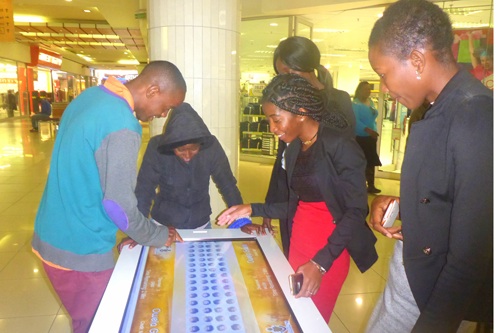
THE young man, Justus Iikukutu, who claims to have remodelled the owela Oshiwambo traditional game so that it can be played on an advanced coin-operated table says some people computerised his idea.
Owela is played on a four-row board of at least eight holes per row, but no more than 32 and always an even number. The counters are pebbles or marula seeds. Known in some regions as //hüs, Owela has other names such as xoros, ogoro, onjune, otjitoto and lochspiel.
A number of tribes in Namibia – Damaras, Namas, Ovaherero, Kwanyama, Ndonga, Kwangali, Mbukushu, Shambyu and Hei//om – play the game.
Iikukutu says he designed his model so that it can be played on a table just like a pool game after the players have inserted a coin.
The International University of Management student said the game can now be played at entertainment centres.
According to Iikukutu, Aron Hamukwaya, the managing director of the National Software Engineering Academy (NSEA) took his model and computerised it.
Around February or March this year, Iikukutu said he responded to a newspaper advertisement calling for people with innovation ideas to attend a seminar at the Namibia University of Science and Technology (NUST).
He said one of the requirements was for interested people to write about their ideas in detail and those with viable ideas would get sponsorship from government to develop the product.
“I did not want to send my information as I know people can steal other people’s ideas,” he told The Namibian. He, however, still went ahead to do so.
He said the organisers wrote to him, telling him that his idea was outstanding and that they would contact him regarding logistics.
But they never came back to him and with time, Iikukuu said, he gave up on the matter and wished for some other similar opportunity. However, a friend he had shown his invention, called one evening telling him that he had seen some young people showing off an owela computerised game to the information minister Tjekero Tweya on TV.
According to the friend, the people seemed to have secured N$5 million to develop, market and sell their product commercially.
“They stole my idea. I knew and suspected it long ago. The people who organised that innovation at NUST stole it or worked together with somebody else to steal it,” he fumed.
Iikukutu said they changed the name from ‘owela modernised game’ to ‘owela computerised game’.
“They told me my idea was brilliant, but unfortunately they wanted only to copy my invention,” he fumed, adding he needs help to investigate those who organised the workshop.
Iikukutu says when he checked on Hamukwaya’s Facebook profile since he was mentioned in the news clip as the inventor, he saw pictures of people standing at the ‘computerised owela game’. In one picture, people were standing with Tweya.
He also said further searches on the profile show photos of people with NUST logo backgrounds.
This, according to Iikukutu, authenticates the idea that people from NUST worked with whoever stole his idea.
Hamukwaya denied copying Iikukutu’s idea, saying he learnt about Iikukutu’s invention through the media when he was featured in the Informante newspaper last year.
He said, like Iikukutu, somebody also called to tell him someone had stolen his idea, which he started working on in 2012, while Iikukutu invented his modernised game last year in September.
“I did not know about his game or idea until I read about the article, and besides, they are not the same. Mine has software and a touch screen. His is something played with actual marbles. So he cannot claim I stole his idea,” Hamukwaya said.
Hamukwaya, who studied information science and computer technology in Russia, said he is a born inventor and also invented another ‘okawela game’ that won him an award from the National Commission on Research, Science and Technology (NCRST).
He stressed that the owela computerised game has won him a grant of N$500 000 to manufacture many games.