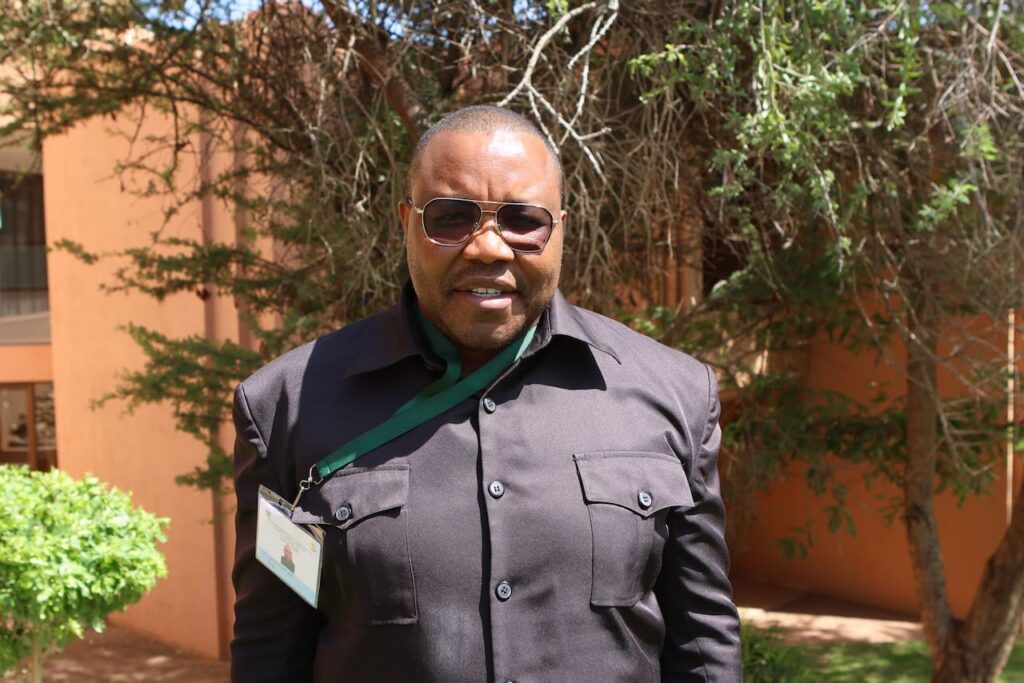
The Namibia National Olympic Committee (NNOC) is seeking partnership with corporates from the oil and gas sector in its quest towards Los Angeles 2028.
NNOC president Nedulipulwa Hamutumwa last week presented a speech titled ‘Beyond the Podium – Leveraging CSI, Oil & Gas and Local Content to Build Namibia’s Sporting Excellence Towards LA 2028 and Beyond’ at the fourth Namibia Oil and Gas Conference and Exhibition in Windhoek.
Representing both the NNOC and the Commonwealth Games Association, Hamutumwa said Namibia stands at the threshold of a new economic era.
“The discoveries of oil and gas off our coast have placed our country firmly on the global energy map and created expectations of investment, employment, infrastructure, technology and economic growth. This rare opportunity must be guarded selflessly and inclusively.
“The fundamental questions we owe to deeply reflect this morning is – what would the country build with this great opportunity?” Hamutumwa asked. “Will we measure success only in barrels produced and revenue generated? Or will we measure it in Namibian lives transformed.”
He said Namibia’s unemployment rate stands at 36.9%.
“Youth unemployment is approximately 44% nationally, rising to around 49% in rural areas. So where will the opportunity come from? I submit today that sport must be part of the answer.”
He said sport is a sector which is funded “after everything else”.
However, sport intersects with education, health, employment, tourism, youth development, infrastructure and national identity, Hamutumwa said.
“That is why Namibia’s sixth National Development Plan (NDP6) identifies sport development as a priority development sector and seeks to increase sport’s contribution to employment from approximately 1% to 3.5% by 2030.”
“NDP6 gives us the policy platform to move from participation towards professionalisation, commercialisation, employment creation and sustainable sporting excellence.”
He added that sport is not simply about medals, but it is part of Namibia’s development strategy.
Hamutumwa said the nation embraces the revelation by the World Health Organisation that approximately 31% of adults globally are insufficiently active, rising to approximately 80% among adolescents.
“Without change, physical inactivity could contribute to almost 500 million new preventable cases of major non-communicable diseases between 2020 and 2030, at a direct healthcare cost of approximately US$300 billion.”
However, he said, that does not fully account for absenteeism, reduced productivity, disability and premature death.
“So we must stop asking only: What does sport cost? And start asking: What does inactivity cost?”
Hamutumwa said Namibia has proven that it can compete globally.
“Our sporting history provides another powerful set of numbers.”
At the Barcelona 1992 Olympic Games, Frank Fredericks won silver in the 100m and 200m. At Atlanta 1996, he won two Olympic silver medals in the same disciplines.
Then 25 years later at the Tokyo Olympic Games, Christine Mboma, at just 18 years old, won silver in the women’s 200m, becoming the first Namibian woman to win an Olympic medal.
This brings Namibia’s total Olympic medals in athletics to five.
“Our Commonwealth Games history tells the same story. Before Glasgow 2026, Namibia had won 24 Commonwealth Games medals. At Glasgow, Team Namibia added another three, one silver and two bronze, bringing our historical total to 27 medals.
“These numbers tell us something important: Namibia does not have a talent problem. We have a challenge of systems, pathways and sustained investment. Our present, however, demands that we move beyond relying on exceptional individuals.”
He said the country’s future must be one where talent is identified early, athletes follow structured development pathways, coaches are professionally developed, decisions are informed by sport science and research, and the best athletes can prepare in world-class environments in Namibia.
“So, the journey is clear: our past proved that Namibia has talent. Our present tells us that talent alone is not enough. Our future must build a system that turns talent into sustainable excellence.
OIL and GAS
“We speak extensively about local content: Namibian jobs, Namibian procurement, Namibian businesses and skills transfer. All are essential. But we must take that conversation further.”
Hamutumwa said Namibia must move from local content to local capability, and ultimately to human capital.
He said sport itself has an economic value chain: coaches, doctors, physiotherapists, sport scientists, nutritionists, psychologists, data analysts, broadcasters, event managers, tourism businesses, logistics companies and technology providers.
“These are not simply sporting occupations. They are economic opportunities. So, I challenge corporate Namibia and our emerging oil and gas industry to move from sponsorship to partnership.”
“From visibility to measurable impact. From once-off donations to long-term investment.”
He added that this is the idea behind the proposed NNOC Foundation, a professionally governed and transparent mechanism through which corporate and private-sector investment can be ring-fenced for athlete development and high-performance sport.
LA 2028 OLYMPIC
“LA2028 gives us a deadline. But Olympic medals are not won at the Olympic Games.
They are won in the years before them, through coaching, competition, nutrition, sports science, medical support, psychology, research, technology and consistent investment,” Hamutumwa said.
“I call upon Namibia’s oil and gas industry, government, corporate Namibia and our development partners to partner with the NNOC to establish a national high performance sport centre for Namibia.”
He said the centre would be aligned with NDP6 and Namibia’s long-term sporting ambitions.
He added that the centre would be dedicated to sport science, sport medicine, strength and conditioning, nutrition, rehabilitation, psychology, performance analysis, research and innovation.
“But let me be precise about what I am really asking for. A building alone will not produce champions. We need dedicated and sustainable funding. Investment in infrastructure. Investment in equipment and technology.”
He said Namibia needs investment in research and development, in coaches and sport scientists, and most importantly, sustained investment in athletes.
“A national high-performance sport centre must, therefore, also be a centre for transition. Preparing athletes not only to stand on the podium, but to stand in the boardroom, on the rig, in the classroom, in the workforce.
“Because a champion’s contribution to Namibia should not end when their competing days do.”