





Only about 1 100 direct jobs would be created if TotalEnergies and its partners proceed with oil production off the Lüderitz coast.
This is according to an environmental and social impact assessment conducted on the Venus Offshore PEL0056/Block 2913B for the French oil giant TotalEnergies.
The assessment for the proposed Venus project points out that the vast majority of the 12 000 jobs expected from the 25-year oil production would be indirect or induced.
Wikipedia says employment created by additional personal spending (such as eating at a restaurant) by both direct and indirect workers is classified as induced employment.
The biggest gain for the Namibian economy would instead be the income generated from selling the oil.
“The project is estimated to contribute between N$536 billion and N$800 billion to Namibia’s gross domestic product (GDP) for the anticipated minimum 25-year project lifetime,” reads the assessment independent consultants conducted.
“Government revenue may total between N$129 billion and N$229 billion, considering a 25-year project time frame,” it says.
The onus would, therefore, fall heavily on the government to prudently use the taxes, royalties and other income from oil to ensure benefits are widely distributed among the population.
TotalEnergies and its joint venture partners Impact Oil & Gas, QatarEnergy International E&P LLC, and the National Petroleum Corporation of Namibia (Namcor) are currently doing another round of public consultations for its environmental and social impact assessment report before getting the Ministry of Environment and Tourism’s approval.
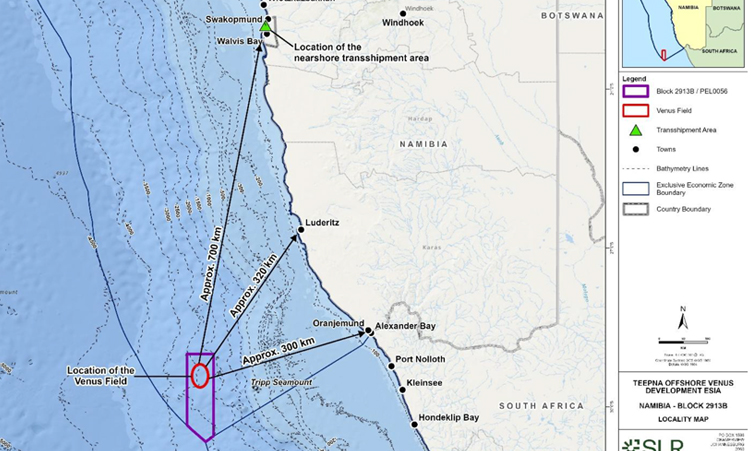
The petroleum exploration licence (PEL) for PEL56/Block 2913B is located 300km from Oranjemund, 320km from Lüderitz and 700km from the main port of Walvis Bay, where the envisioned oil would be exported from.
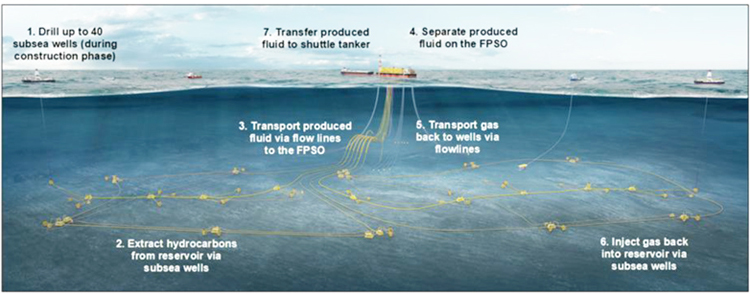
The capital-intensive project aims to extract oil 3km from the seabed after another 3km from the water’s surface.
This involves drilling up to 40 wells, comprising 20 oil-producing wells and 20 gas-injection wells, the report says.
500 DIRECT JOBS
It says 5 000 jobs will be created during drilling and installation, of which 500 will be direct, 2 000 indirect (suppliers) and 2 500 induced.
The installation phase might take up to five years.
When oil extraction starts and continues over the 25 years, an estimated 7 000 jobs will be created.
Only 600 of these jobs are expected to be directly involved in the production of oil, with another 600 indirectly involved, and 800 induced.
“Jobs will be distributed in various parts of Namibia and are important due to the high demand for jobs – especially at coastal towns,” the report reads.
‘JOKE OF THE CENTURY’
Economist Omu Kakujaha-Matundu casts doubt on the impact of the project when it comes to job creation, saying that 12 000 jobs over a 30-year period is “the joke of the century”.
He says multinational companies tend to inflate job creation to get maximum government incentives.
“It is playing with the government’s desperation to obtain some favourable terms and incentives, which is sickening,” Kakujaha-Matundu says.
He compares the situation to the green hydrogen sector, where he says many jobs have been promised that are yet to be seen.
Institute for Public Policy Research director Graham Hopwood says the sector may create fewer jobs than what the government expects.
He says there is not enough data to back up the government’s optimism, and there has not been much transparency and consultation either.
“As far as the oil and gas government aspiration is concerned, the government seems to have overly set the tone that more jobs will be created when in actual fact it is not entirely true,” Hopwood says.
He says the government should rather focus on levy collection in the sector, which could be used to create jobs.
Landless People’s Movement youth leader Duminga Ndala says the party has to date only seen projections and targets rather than realised numbers in the sector.
She says the sector could, however, partner with local businesses to strengthen the development of the country’s small and medium enterprise sector.