



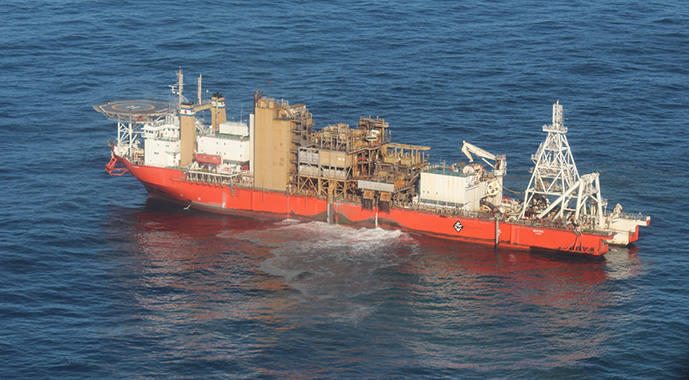
ORANJEMUND – A vast mechanical monster rises from the Atlantic Ocean off the coast of Namibia, leaving a huge swell in its wake as seawater pours off its surface.
The 285-tonne giant, dubbed ‘the butcher’ by its operators, is diamond miner De Beers’ hi-tech tool to collect the precious stones.
After several hours of maintenance, the deep-sea vacuum is lowered again into the water on steel cables from the Mafuta vessel.
It dredges the ocean bed, sucking thousands of tonnes of silt and sediment onto the ship to be sifted for diamonds.
Diminishing returns from its mines in the arid Namib Desert prompted De Beers to plot an off-shore future.
A flotilla of five vessels armed with undersea suction devices have been scouring the Atlantic seabed for more than 10 years in pursuit of stones washed out to sea by the Orange River.
Their initial haul of deep-sea diamonds was a world first, and surprised even the experts leading the project.
Last year, Debmarine Namibia, a joint venture between De Beers and the Namibian government, produced 1,2 million carats-worth of diamonds – two-thirds of Namibia’s total haul.
“Onshore operations are at a crossroads,” said De Beers Namibia resident director Daniel Kali.
“We believe there’s still value in diamonds to be extracted onshore, but it will require massive capital investments. Offshore, I think there’s definitely a long future ahead.”
The Mafuta diamond mining vessel can be reached with a short helicopter ride from the Oranjemund mining hub on Namibia’s south-western tip.
The vessel is 170-metres long, 33 metres high and has a crew of 98.
“It’s the largest marine diamond mining vessel in the world,” said Mafuta captain Justin Barrett.
“The Mafuta produces almost 50% of Debmarine Namibia’s annual production.”
One hundred metres below the Mafuta, “the butcher” slowly trawls the seabed at a rate of one kilometre an hour.
A pipe carries the sediment to the boat where it is sifted, cleaned and returned to the sea. Only possible diamond deposits, identified by X-ray, are taken deeper into the boat for processing.
The diamonds are then held under tight security while they are cleaned and sorted into storage tins.
Everything is so automated that no human hand need ever touch the valuable haul.
To fight the risk of piracy on the high seas, the Mafuta’s cargo is transferred to the Namibian capital Windhoek three times weekly.
Debmarine Namibia has so far only touched 10% of its 6 000 square kilometre sub-Atlantic concession.
But De Beers is confident that it has struck a rich seam of underground value.
The diamonds it dredges up are high quality and fetch up to US$600 (520 euros) per carat, more than twice what diamonds from De Beers Botswana can command.
“It’s the richest marine diamond deposit known in the world,” said Jan Nel, Debmarine’s operations manager. “It should take us about 50 years to mine it out.”
But the long-term extraction plan has alarmed environmentalists.
“The principal impact is disturbance of seabed sediments,” said Saul Roux of the Centre for Environmental Rights (CER), adding that the top 20 centimetres of sediment and seabed wildlife are “unavoidably destroyed”.
The CER has called for a moratorium on underwater mining while independent scientific studies into its impact are completed.
“There is disturbance, but the natural events around us are far in excess, and the rehabilitation period is fairly short,” he noted.
As the environmental arguments continue, nothing is likely to upset the partnership between Namibia and De Beers, which has just been renewed for ten years.
De Beers is Namibia’s largest source of tax receipts, paying a bill of US$233 million in 2016 alone.