




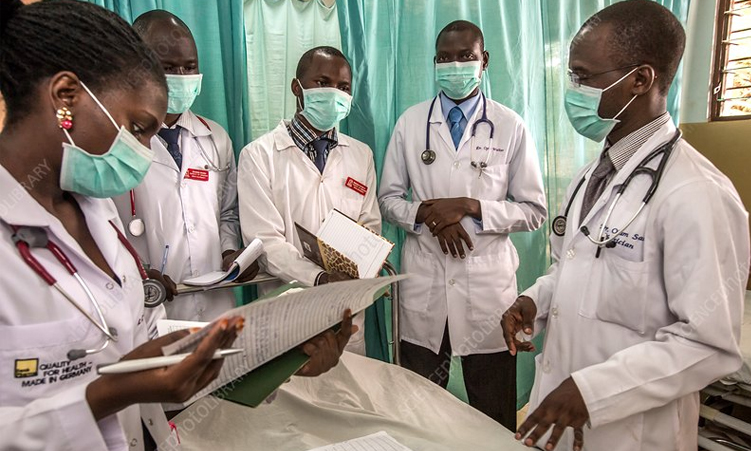
More than 200 Namibian students accepted into medical and health-related programmes abroad face uncertainty after NSFAF rejected their funding applications.
The students were met with rejection letters for both tuition and non-tuition fees on grounds that their fields are not on the priority list for funding.
The letters, issued by Ministry of Education, Innovation, Youth, Sport, Arts, and Culture executive director Erastus Haitengela and seen by The Namibian yesterday, state that: “Kindly note that the course you have applied for does not appear on our priority field of study list; awards will only be granted to applicants studying towards priority fields of studies.”
One of the affected students, Angelina Thikundeko, yesterday said she was shocked to learn that medical fields, which have always been regarded as priority fields, are suddenly non-priority.
She added that information about medical fields being considered as non-priority fields only reached them after they had received admission offers.
“Medicine fields must still be viewed as a priority as our country is still faced with a shortage of local doctors and specialised health workers. If it’s really a new policy, it was never formal and clearly communicated to us as students before we started applying for funding.
“NSFAF cannot just decide medicine is a non-priority field and reject us out of the blue. We planned our futures based on the previous understanding and worked for years to meet the requirements to study medicine. The medicine courses offered locally have limited space, and many of us were rejected due to that,” she said.
Thikundeko said since it was never formally communicated, the Namibia Students Financial Assistance Fund (NSFAF) should retract its funding rejection for medical students who applied for funding for the 2026 academic year.
“We appeal for NSFAF to consider funding us as a transitional agreement, otherwise hundreds of us will lose admission offers and will be forced to stay at home. We are really stressed about this situation because our parents cannot afford to pay for us, and the government was our only hope.
“I am very disappointed because I really don’t want to pick a new course next year and waste this year. This new system has shattered all my hopes,” she said.
Another affected student, Pius Amungulu, says he applied to study bachelor of medicine, bachelor of surgery (MBChB) in Zambia because he was rejected locally due to the limited space.
He says seeing that studying abroad is costly and his family could not afford it, he relied on NSFAF to grant him funding.
“I met the funding requirements, but unfortunately my application was rejected due to the so-called new subsidised funding system. The system has really failed so many students’ dreams because we are not able to study the fields that we are passionate about.
“After NSFAF rejected my application, I tried to apply at social security, but they do not fund medical studies. I missed my January intake, now I’m planning on reapplying for the June/July intake. The government should really consider medicine as a priority field and cater for every medical student, whether studying abroad or locally,” he says.
An MBChB student in Zambia, Rejoice Amos, yesterday said her sister and mother had to cough up about N$19 000 for the first semester to secure her spot, as well as and additional N$7 800 for the study permit.
She said she hopes that NSFAF will consider her appeal for funding.
“This rejection has affected my dreams and career because studying medicine is expensive and it requires a lot of years to be trained as a doctor. I would like our government to construct a fair-based system where each student is given equal rights by NSFAF,” she said.
Education minister Sanet Steenkamp, when reached for a comment by The Namibian yesterday, noted that an official response will be issued in due course.