



Winter is the season for air-dried, cured and flavoured meat known locally as biltong.
The word originated from the Dutch roots meaning tongues (or strips) of rump (meat). Even through the word may have European roots; the practice of curing meat with salt and then drying it in order to preserve it predates the arrival of the Europeans in our part of the world.
Early inhabitants of what is today southern Africa and particularly the Khoi widely used curing and air-drying as a technique for preserving meat and fish.
The process is relatively simple: The meat is first cut into thin strips to reduce drying time, then treated with salt in order to draw moisture from the meat and to protect the meat against bacterial growth. It is then hung in a cool dry place for a number of days to dry. Meat treated as such could be stored for a considerable period of time. It could eaten as is, or pounded into a fine powder to be added to staples such maize porridge or bread flour. Some cultures rehydrate the dried meat before boiling it into stews and soups or shallow frying it.
Locally, eedingu and Ozombuatwa are dishes based on salt cured, air-dried meat.
Most frontier cultures have air-dried meats as part of their traditional food culture. As such, biltong is not unique to southern Africa. What is unique though is the combination of spices and, as such, the flavours of biltong.
There are possibly as many biltong recipes as there are biltong makers, but its most common form only has a few ingredients: Meat (venison or beef), salt, vinegar, coriander seeds, black pepper, nutmeg and perhaps Worcestershire sauce.
Biltong is usually made during the winter when climatic conditions are better suited for air-drying meat. The best temperatures range between 10 and 18°C and it is preferable to hang the meat where there is a free flow of air and an absence of flies.
Humidity levels for some air-dried products need to be between 60 and 80%. If the meat is hung outside a protected space such as a biltong cabinet or a mesh enclosed closet, the meat should be covered by a jambon sac or wrapped loosely with muslin cloth to prevent flies from laying their eggs on the surface or in the crevices of the meat. If you are blessed to be one of the more innovative and mechanically handy among us, you may be able to convert an old refrigerator into a specialist curing-chamber.
Obviously there is more to air-dried meat than biltong (or its close southern African relative droeë wors, for that matter). Carne seca is dried beef used in Mexico with onions, tomatoes, green chillies and eggs; cecina is dried meat similar to dry-cured ham endemic to Spain; ch’arki (alternatively ) is dried llama meat from South America and the root word for the American dried meat product called ‘jerky’; in Nigeria kilishi is made by covering dried sheets of meat with a paste made from peanut butter () before being dried even further.
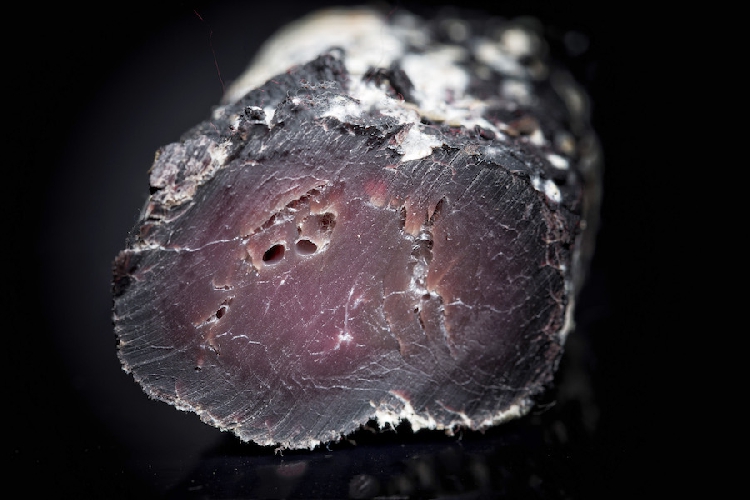
Like many Namibians, I have had enough biltong to last me most of the way on a journey to circumvent the earth. But this year I decided to try new recipes and one that I found particularly interesting is bresaola: Meat cured and marinated in red wine before being air-dried into something that resembles biltong but with very different flavours. The fresh flavours of the red wine and herbs do it for me, and I’ll do it again. Instead of using the usual cuts of beef, I used springbok loins because I had quite a lot of it. As it was getting hot already, I dried the meat hanging in my small seldom-used refrigerator positioned outside on the patio. The drying time will depend on the cut of meat you use (bresaola is usually made from much thicker cuts of beef) so keep checking until you are satisfied. If you are concerned with the white mold that will form on the outside, wipe it from your bresaola with a cloth moistened with white vinegar.
Slice the bresaola thinly and serve as part of a home made charcuterie platter.
4 kilograms springbok loins
120 grams course sea salt (it must be 3% of the weight of the meat), 12 sprigs rosemary, 12 bay leaves, 4 cloves garlic, peeled and
crushed. 1 tablespoon black peppercorns (cracked), 5 to 6 strips lemon zest 750 mililitres red wine.
1. Remove all sinews and silverskin from the meat.
2. Add all the dry ingredients in a food-standard plastic container. Add the meat and turn to coat it well. It is essential that all surface area of the meat is coated with cure. Cover the container and leave in the fridge for four days. Turn the meat every other day.
3. After four days, pour the bottle of wine over the meat and return the meat to the fridge. Turn the meat once every day for five days. After five days, remove the meat from the marinade and pat dry with a tea towel or kitchen cloth.
4. Tie the meat with butchers twine to help it keep its cylindrical shape. If you are doing this in summer, hang the meat in your refrigerator for around three weeks. Depending on the size of the loins, the Bresaola may be ready in two weeks. It should be allowed to hang for at least 10 days. In winter the meat could be hung in any dry, cool and draft place such as you garage or stoep.
5. You may want to trim the harder outside layer of the bresaola before slicing it thinly across the grain.