The Namibia Statistics Agency (NSA) has fully transitioned to an automated Python-based processing system for compiling the Namibia Producer Price Index (NPPI), leading to retrospective revisions of producer price estimates spanning back to 2015.
The structural shift was officially revealed in the NPPI bulletin for the second quarter of 2026, released in Windhoek on Friday.
NSA statistician general Alex Shimuafeni says the agency replaced its legacy MS Excel-based system to significantly enhance data precision, error detection, and mathematical modelling.
Under the former Excel framework, missing price entries were calculated using an unweighted class mean method.
The new Python-driven engine instead automates missing value imputations by calculating a weighted average of observed price relatives within the relevant product group.
This ensures items with larger market turnover exert proportional influence over sub-industry trends.
“This methodological enhancement is considered an improvement, as the weighted average approach produces imputed values that more accurately reflect actual price movements, thereby enhancing the quality, accuracy, and reliability of the indices,” Shimuafeni says.
Beyond imputation, the Python system introduces automated validation protocols across individual establishment files, flagging extreme price swings and data entry errors from quarterly questionnaires.
The system enforces a strict rule where missing price entries can only be imputed for up to three consecutive periods before requiring a replacement item, which is formally integrated after two consecutive price observations.
Using a modified Laspeyres formula, the system aggregates basic output prices, excluding value-added tax, excise duties, and transport costs.
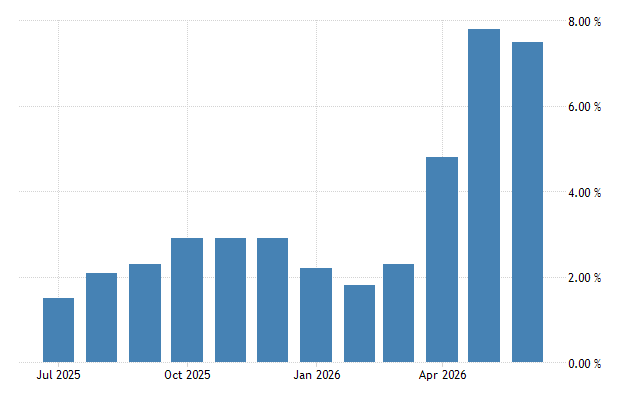
The technological upgrade comes as domestic producers face severe inflationary pressure. Overall producer price inflation surged by 50.7% year on year in the second quarter of 2026, following an 8.8% quarter-on-quarter increase.
This spike was largely driven by a 79.8% annual expansion in the mining and quarrying sector, boosted by strong gains in uranium (43.5%), gold (20.8%), and diamonds (17.1%).
Manufacturing producer prices also rose by 23.5% annually, propelled by higher costs in rubber and plastic products (74.9%) and diamond processing (31.2%). Warning of potential downstream impacts, Shimuafeni notes, “such sustained increases in producer prices may eventually be transmitted to consumer prices, depending on the ability of producers to pass these higher costs on to final consumers.”
– Nampa