


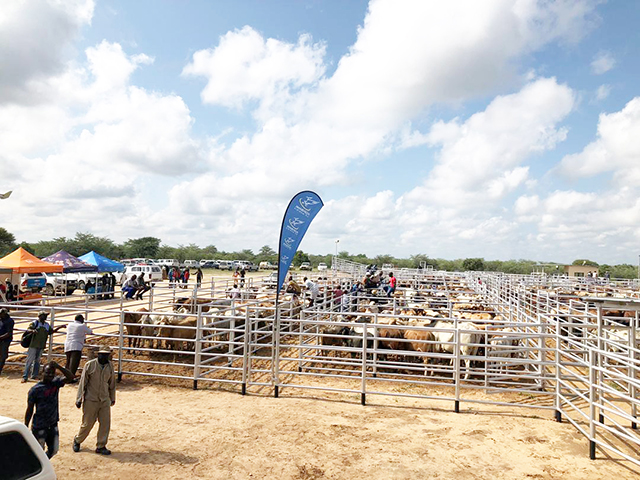
THE community of Talismanus in the Omaheke region’s Otjombinde constituency last week received a livestock marketing facility from the United Nations Development Programme in partnership with the government.
The facility, which will also serve neighbouring areas, has an auction kraal which caters for small livestock (sheep and goats) and large livestock (cattle).
The facility was constructed through the Sustainable Management of Namibia’s Forested Lands (Nafola) project, which was funded by the Global Environment Facility in partnership with UNDP to the amount of N$9,2 million.
Speaking during the inauguration, agriculture minister Alpheus !Naruseb urged local farmers and livestock traders to use the facility to engage in livestock marketing in the region.
The minister advised farmers to manage their livestock sustainably by reducing their herds through trading.
This would also help prevent overgrazing, which according to !Naruseb, is one of the challenges identified during the formulation stage of the Nafola project.
It would, in addition, help curb major losses through high numbers of livestock dying during droughts.
UNDP country representative Alka Bhatia said the construction of the livestock marketing facility is an example of how her agency, the government and local stakeholders can work together to deliver on the promise to improve the lives of citizens.
“As the UNDP, we are convinced that this facility will be used for its intended purpose, such that it will contribute to increased livestock take-off, further contributing to the reduction of livestock pressure on the forestry resources in this constituency,” said Bhatia.
Issy Kamutueze, a farmer from Otjombinde, welcomed the development, saying the construction of the facility is an improvement on what the community previously used to trade their livestock.
Charles Hambira, another farmer in the constituency, said the facility will provide much-needed safety for their livestock during auctions.
“The kraal is very well constructed. Although the prices at which we are selling our cattle are not as high as they used to be because the animals are still recovering from the effects of the drought, I am happy that we have a place of this standard to sell our livestock,” he said. – Nampa