Despite the promise of sectoral expansion, macroeconomic stability, and social reform under the fifth National Development Plan (NDP5), implementation outcomes fell short of expectations across multiple dimensions.
The shortfalls were in employment creation, industrial diversification, education relevance and subnational delivery.
“These shortfalls underscore the structural and institutional barriers that any new plan must confront,” a report by Simonis Storm Securities released last week reveals, while indicating that NDP5 offers critical lessons that shaped the urgency and design of NDP6.
According to the report, NDP5 revealed a structural decoupling between gross domestic product (GDP) growth and employment generation, and high-performing sectors such as mining, construction and finance were capital-intensive and technologically driven. This yields limited labour absorption despite robust output.
The labour market, however, remains misaligned with economic transformation, with high youth unemployment and a persistent informal sector masking deep vulnerabilities in rural and peri-urban labour dynamics, the report indicates.
Productivity gains also did not translate into jobs, largely due to low skills intensity and weak domestic value chains.
Efforts to shift from extractive dependency to industrial production faced chronic constraints such as high input costs, underdeveloped industrial finance ecosystems, scale limitations and weak backward linkages.
Although the ‘Growth at Home’ strategy laid a foundational framework, the report states that its translation into investable, job-rich manufacturing activity was minimal.
It further states that the slow roll-out of supportive infrastructure, erratic regulatory approvals, and an under-skilled workforce further limited progress.
NDP5 covering the period of April 2017/2018 ended during March of the 2021/2022 financial year.
The National Planning Commission (NPC) undertook the terminal review of the NDP5 during May to June 2023 which was released on 26 July 2024, to assess the extent to which NDP5 goals and targets were achieved, identify the challenges experienced, and draw lessons to inform the formulation and implementation of future plans.
OVERALL NDP5 PERFORMANCE
According to the NPC terminal review report, Namibia during NDP5 experienced mixed results.
The economy experienced deterioration in most economic fundamentals attributable to fluctuations in commodity prices and investments, drought and devastating effects of the Covid-19 pandemic, as a result the economic growth targets were not achieved.
The average negative growth over the NDP5 period exacerbated inequality, exclusiveness and risks unsustainable development in the long run.
However, the report states that Namibia maintained the level of human development as it was at the start of NDP5.
“In terms of three basic dimensions of the human development index, the decent living standard dimension was much of a downward pulling factor offsetting progress in other dimensions. But Namibia continues to show prudent management of its environment despite its natural fragility,” reads the report.
NDP5 performance only reached 58%.
Despite this, improvements were made to road networks, social safety nets were increased, revenue from levies for environmental protected areas was improved, and performance in primary education was enhanced.
By 2022, the proportion of severely poor individuals has dropped from 11% in 2016 to 5%.
Popular Democratic Movement president McHenry Venaani questions what informed the decision to move to NDP6 if NDP5 performance was dismal at best.
POOR PERFORMANCE
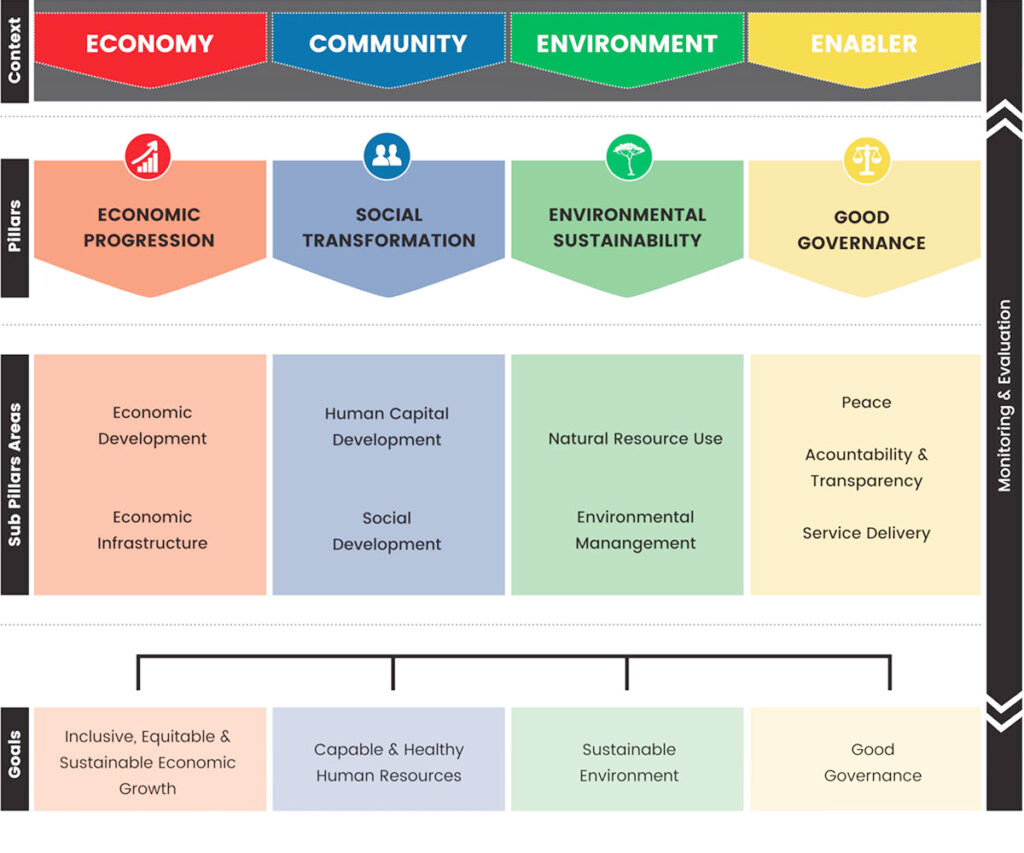
According to the NPC, the first pillar of NDP5, the economy, had an average economic growth target of 4.7%. The growth targets were progressive from 2.5% at the beginning of the plan to 6.2% at the end of the plan in 2021/2022.
The outturn was, however, an average decline of 1.1%. The registered decline was mainly attributed to negative growth rates of 1%, 0.8% and 8.1% recorded in 2017/2018, 2019/2020 and 2020/2021.
Unemployment target reduction was set at 24% but only managed 34%.
The Namibia Housing Enterprise in August 2024 revealed that Namibia’s housing backlog stood at a staggering 300 000, requiring an annual construction of 30 000 housing units to reduce it – pillar two on social transformation. Poor sanitation was also highlighted.
Regarding pillar three on the environment, poaching cases increased. For pillar four on good governance, the crime rate also increased and the implementation of the decentralisation process was slow.
On health, while Namibia maintained relatively strong national capacity, the system remained deeply unequal.
REPUTATIONAL DAMAGE
The Simonis Storm report indicates that governance suffered reputational damage following high-profile corruption scandals, notably Fishrot, which revealed systemic weaknesses in procurement and political accountability.
While prosecutions are ongoing, the slow pace of judicial processes and insufficient asset recovery have dampened public trust in institution.
The report stated that the Anti -Corruption Commission lacked sufficient autonomy, capacity and legal backing to act decisively.
By 2022, the proportion of food insecure individuals has dropped from 25% in 2016 to 12%, and food production has increased by 30% cumulatively over the NDP5 period.
NDP6 DESIRED INTENTIONS
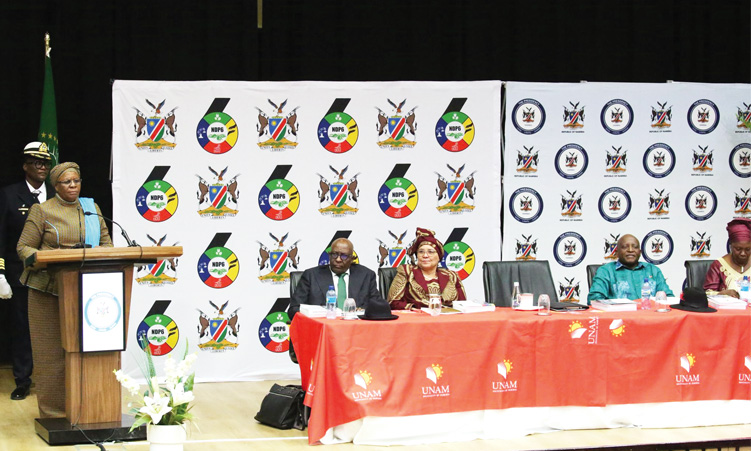
NDP6 which was launched on 18 July by president Netumbo Nandi-Ndaitwah, built on from NDP5, intends for Namibia to achieve an economic growth of at least 7% or more over the NDP6 period and increase the employment rate from 63 to 75%.
It further intends for secondary industries to contribute 25%, while manufacturing contributes 18% to GDP, and to employ 70 000 people.
It also wants to create 30 000 green jobs by 2030.
By 2030, the goal is to achieve an employment rate of 75%, up from 63.1% in 2023. Additionally, the number of people with disabilities who have access to essential services has increased from 3 015 to 4 850.
Another goal is for Namibia to produce 80% of its national food requirement, up from 60%. The plan also aims to unlock housing opportunities at scale for urban and rural residents by 2030, increasing the number of serviced plots from 25 111 to 50 000 and houses constructed from 12 598 to 55 126.
It is also intended that Namibia will acquire land for redistribution to previously disadvantaged landless Namibians, increasing the total from 3.5 million to 3.9 million hectares.