President Netumbo Nandi-Ndaitwah has recycled her old colleagues to serve as the new heads of diplomatic missions.
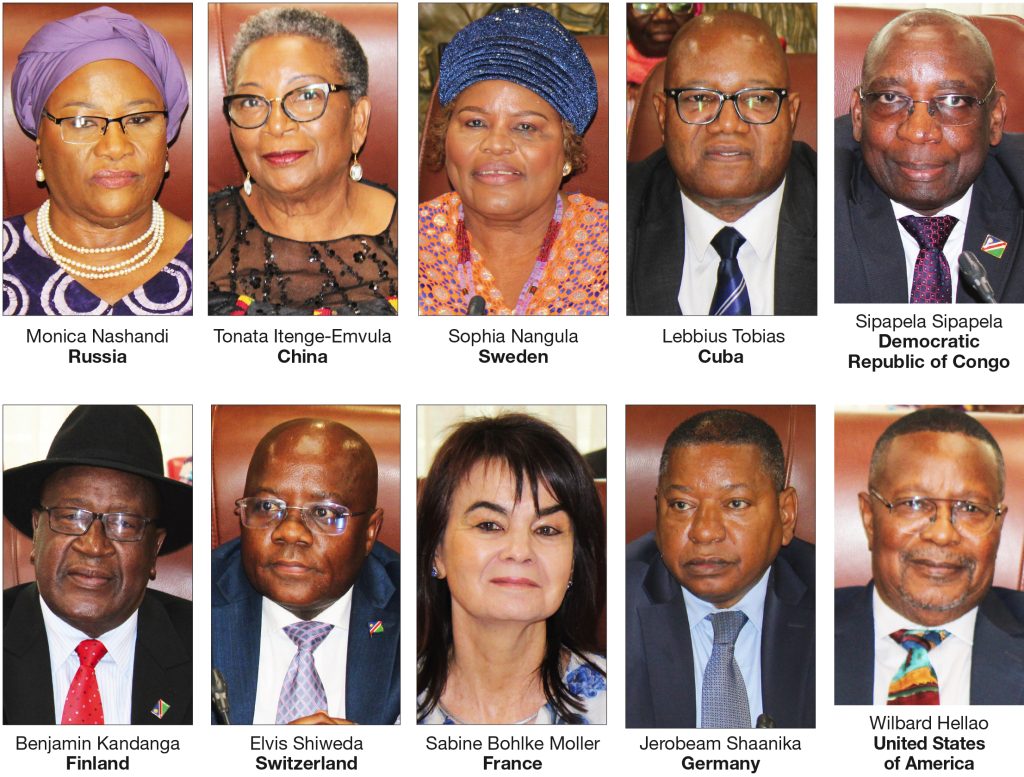
The 10 new ambassadors will serve for a period of four years, the president announced yesterday.
The new status quo is demonstrated by the appointment of a former personal assistant of founding president Sam Nujoma, Jerobeam Shaanika, as Namibia’s ambassador to Germany.
Shaanika served in various diplomatic missions from 1995 to 1999, 1999 to 2003, 2007 to 2010 and 2010 to 2013.
Prior to his appointment, he served as the deputy executive director of multilateral relations and cooperation in the Ministry of International Relations and Trade.
This move has, however, been questioned by former ambassador Pius Dunaiski, who says the announcement of the new ambassadors is surprising since many old names were recalled to serve again at an advanced age.
“Most of the ‘leaked’ persons were not named, which is a confirmation that altogether, the group of retirees left the headquarters (HQ) with a thin base and a lack of real diplomatic capacity and skills, and strengthening the HQ became increasingly urgent,” he says.
In this context, Dunaiski says strong diplomatic ambassadors were recalled to “prop up a weak structure at home”.
He says the appointment of old diplomats should also be seen against the backdrop of ‘jobs for close comrades’, terming this as unfortunate.
“They are very experienced diplomats, most of whom had served for years in the diplomatic corps before Namibia’s independence, and they could do well at their new posts. I can only wish them well for their important, high-profile, and key international posts for Namibia,” he says.
Political analyst Sam Kauapirurua has also raised concerns over the appointment of the old guard, given the fact that the president’s Cabinet comprises a mixture of young and old.
“Now when it comes to the diplomatic corps, I think we have departed from that philosophy of going for young, new blood.
‘DICHOTOMY’
“She seemed to have gone for the old guard, the tried and tested, so I do find a dichotomy there,” he says.
Kauapirurua says the president appointing key senior civil servants is questionable.
He believes the geopolitical order in Germany, the Russia-Ukraine conflict, Israel’s war on Gaza, Donald Trump’s presidency, and European matters could, however, explain why she went for the old guard.
Kauapirurua says the new ambassadors have their work cut out for them in ensuring they market Namibia well amid ongoing global tensions.
He says the government has great ideas but lacks implementation.
“I think their key task is to unlock economic and sociopolitical opportunities for Namibia, primarily promoting this country of three million customers to the global market to say we matter as a country.
“We have a vision, we have people. We have natural resources, and we have aspirations,” he says.
Kauapirurua says the president has a clear agenda, which was communicated through the sixth National Development Plan (NDP6).
‘NO SURPRISE’
Meanwhile, Erika Thomas, a political science lecturer at the University of Namibia, says she is not surprised by the president’s move, as it was expected.
“I have time and again raised the issue of institutional memory, and this is a manifestation that I was right. The ministry in charge of the diplomatic corps lacked tried and tested ambassadors.
“It is no surprise that the president decided to recycle them, because she needs them now more than ever,” she says.
Thomas says the president had no choice but to appoint people she trusts – especially given ongoing geopolitical tensions.
She says the president was rewarding the loyalty of many of the appointed ambassadors, who have served the party for many years.
The previous names tipped to be appointed as ambassadors, such as Alfredo Hengari, Yvonne Dausab and Esther Muinjangue, could have angered many loyal Swapo members had they been appointed, Thomas says.
She cautions that it seems this is the last group of people representing institutional memory, and while still alive they must now pass their knowledge on to upcoming young diplomats.
Thomas says corruption robs the youth of opportunities to become ambassadors – a position requiring a clean record.
Nandi-Ndaitwah yesterday said she considered the appointments based on the experience to navigate bilateral relations during a time of shifting geopolitical dynamics, and an era marked by uncertainty, diminishing global security and stability, as well as rising economic protectionism.
“I urge you to identify opportunities for our countrymen and women, particularly the youth. Work tirelessly to secure market access for our products and connect fellow citizens with skilled individuals and enterprises in industries such as the creative sector,” she said.
Tonata Itenge-Emvula – China
Gebhard was appointed as Namibia’s first woman ambassador to the Nordic countries by former president Sam Nujoma in 1991. Her last role in the government was as ministerial special adviser in the then Ministry of Gender Equality.
Monica Nashandi (65) – Russia
Nashandi previously served as deputy chief of protocol at State House before she was moved to the then Ministry of Foreign Affairs. From 1999 to 2005, she served as Namibia’s High Commissioner to the United Kingdom and Ireland.
Sophia Nangula – Sweden
Nangula is a veteran ambassador who represented Namibia in Ethiopia, at the African Union (AU) and in Zimbabwe. In 2011 while in Ethiopia she was accused of abusive behaviour after she allegedly instructed security guards at an AU meeting in Addis Ababa to throw out her deputy, Linda Scott. It was reported at the time that Nangula was transferred to Ethiopia from Zimbabwe after complaints about misbehaviour. At the time, she allegedly also had run-ins with a former deputy. Nangula and Scott were recalled from Ethiopia in 2012.
Benjamin Kandanga (68) – Finland
Kandanga is a veteran diplomat who served as Namibian high commissioner to Malaysia and concurrently served as ambassador to Thailand, Indonesia and Philippines.
Jerobeam Shaanika – Germany
Shaanika served as a former president Sam Nujoma’s personal assistant before entering the diplomatic service. He also served as Namibian diplomat in Cuba, New York, France and the United Kingdom. From July 2022 until his appointment yesterday, Shaanika was the deputy executive director for multilateral relations in the Ministry of International Relations and Trade.
Sabine Moller (62) – France
Moller has served as Namibia’s high commissioner to the United Kingdom. She reached the retirement age of 60 in 2023.
Lebbius Tobias (58) – Cuba
Tobias was a teacher and the chairperson of the Namibia National Teachers’ Union, before being elected as Tsumeb’s constituency councillor in 2004.
Sipapela Sipapela (61) – Democratic Republic of Congo
In December 2020, Geingob appointed him as Namibian ambassador to Congo (Brazzaville). Sipapela once defended a N$178-million development budget for State House extensions in the regions and abroad during former president Hifikepunye Pohamba’s term, arguing that the president deserves State House extensions and shouldn’t have to stay in hotel rooms “as many evil things” happen in these rooms.
Elvis Shiweda – Switzerland
Last year, former president Nangolo Mbumba recalled Shiweda from Senegal with immediate effect. He was cleared by the Ministry of International Relations and Cooperation after Namibian Sun reported that a staff member claimed she was sexually assaulted by him in Senegal in August 2023.
Wilbard Hellao – United States
He was first appointed as Namibian ambassador to Sweden by former president Sam Nujoma in 1999.