





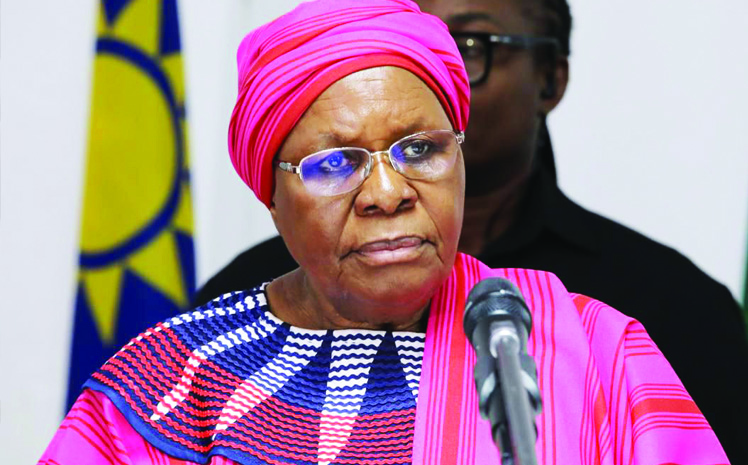
President Netumbo Nandi-Ndaitwah at the official opening of the 26th Annual Meeting of the Council of Traditional Leaders at Ekamuti Guesthouse, Ondangwa – 8 September 2025
I wholeheartedly welcome your kind invitation for me to officially open the 26th Annual Meeting of the Council of Traditional Leaders, taking place here at Ondangwa, in the Oshana region.
As this is my first opportunity to address the council in my capacity as president of the Republic of Namibia, I extend my warmest greetings to all our traditional leaders and delegates to this meeting with a deep sense of humility and great respect.
I, in the same vein, commend the organisers for ensuring that traditional leaders from across the length and breadth of the country are here to discuss pertinent issues that impact the socio-cultural development of our traditional communities and Namibians at large.
I take this opportunity to congratulate chief Gilbert Muhongo Mutwa of the Masubia Traditional Authority and hompa Eugene Siwombe of the Uukwangali Traditional Authority, who were recently installed as traditional leaders of their respective authorities and are attending this council meeting for the first time in their new capacities.
While welcoming you to this esteemed body of wise men and women, I remind you that your work has been ranking behind as your communities have been dragged into succession disputes for a very long time. Such conflicts are, by their nature, divisive.
Therefore, I appeal to you to act swiftly and spare no effort in uniting your communities, because it is only through unity that we can collectively achieve the bold socio-developmental plans we have set for ourselves as a nation.
On this occasion, we reflect on the life of our esteemed leader, the late Sam Nujoma, founding president and father of the Namibian nation, a strong supporter of traditional and cultural norms, who passed away on 8 February 2025, as well as leaders of traditional communities who also passed on during the course of this year.
I remember chief Tjimbware Thom of Vita Traditional Authority, chief Josef Max Haraseb of the /Gaio-Daman Traditional Authority, chief Daniel Shooya of the Uukolonkadhi Traditional Authority and senior traditional councillor Gerson Kunomundu Katjirua of Ovambanderu Traditional Authority during the same period. I have also noted the passing of the former advisor to the Ministry of Urban and Rural Development, Philip Keripuu Tjerije, who played a significant advisory role in traditional affairs.
I respectfully request that you rise and observe a minute of silence. May their souls continue to rest in eternal peace and may their legacies inspire renewed dedication to our shared vision of a peaceful, secure, and united Namibia.
When I took the oath of office on 21 March 2025, I vowed to be the president for all Namibians, and to lead our nation with integrity and accountability. Likewise, I implore you, our traditional leaders, to lead by example, to promote dialogue, transparency, accountability, rule of law, and to ensure that we succeed in our collective fight against corruption in every sector of governance, including in your respective traditional authorities and communities.
I have said it before, and I will say it again, that corruption is like a cancer that eats into the very fabric of society, leading to misallocation of resources and thereby deepening societal inequalities, increasing poverty and unemployment. Corruption could also occur when communal land, under the custody of traditional authorities, is sold to the highest bidder.
If these practices are carried out in your areas of jurisdiction, whereby you deny your less privileged subjects a piece of land to live on and practise farming to feed their families, that practice is to be brought to an end. You have heard me say that it is no longer business as usual, and this also applies to traditional leaders.
We all have a responsibility to deliver quality service to our people within our respective areas of responsibility. Join hands with the government to foster unity of purpose.
Please familiarise yourselves with the policies and programmes aimed at creating jobs for our young people, which aim to bring tangible socio-economic development to your communities through proper land management, as you work on behalf of the government in this unitary state of ours.
I therefore call upon all traditional leaders to support the government in the implementation of the sixth National Development Plan (NDP6) to achieve our developmental objectives as stated in Vision 2030.
Our business is to find sustainable solutions that contribute to improving the quality of life for the people we are called to serve.
One of the most significant challenges facing the nation today is the persistent rise in the unemployment rate, particularly among young people. According to the Namibia Statistics Agency, the youth unemployment rate is at 44,4%, which is unacceptably high. Therefore, in our efforts to find solutions to the unemployment situation, I need you to identify viable and legitimate endowments, competitive advantages and opportunities in each of your localities. Let us utilise communal land as a form of capital that supports investment in community development and job creation.
Pursuant to Article 102(5) of the Namibian Constitution and section 2(a) of the Council of Traditional Leaders Act, the council has an important responsibility of advising the president on the control and utilisation of communal land in the country. In relation to the aforementioned, when the government needs communal land for development, there should be no negotiations.
I therefore commend traditional leaders for availing land to the government and private sectors to establish green scheme farms and other agricultural initiatives by private investors, such as grapes and blueberries.
Recently, hompa Sofia Kanyetu of the Shambyu Traditional Authority has made land available to the government for the establishment of a watermelon fruit processing facility.
I am also aware of land that has already been allocated, especially in the Zambezi region, by our traditional leaders, which has not been utilised for years. I assure you that that land too shall be put to production soon.
I have recently visited the green scheme farms in Zambezi, Kavango East, Kavango West and Omusati regions. I am happy with the progress so far, compared to when I visited some of those farms last year. I came back very disappointed as they were not operating at their expected potential. The progress I have seen is encouraging, people are highly motivated, a lot has been done, and what remains will be done when every citizen plays a part.
The 8th administration, under my presidency, is determined to unlock the full agricultural potential of Namibia and position our green schemes as models of excellence in sustainable development. Together, we can transform green schemes into engines of food security and create sustainable jobs for our young people.
I am burdened by the never-ending infighting and leadership succession disputes that continue to prevail in our communities across the country, to the extent that the integrity of our traditional authorities has come into question.
As I am speaking to you now, out of 53 recognised traditional authorities, there are more than 10 without leadership due to succession disputes.
Regrettably, the government is drawn into the midst of these avoidable disputes, which not only cause divisions among communities but also consume necessary resources that would be better allocated to matters of priority, such as the war against poverty and disease. Such disputes also undermine community unity, eroding moral and cultural values that can lead to a loss of cultural identity.
Customary laws that govern succession should be understood, respected, and complied with. I appeal to all traditional authorities to intentionally seek to resolve all disputes and install your rightful leaders as a matter of great importance and urgency. You cannot continue to deny your subjects the necessary services that could be derived from a proper traditional governance system.
Forgoing the traditional solutions and taking these disputes to modern-day courts, which are based on a mixture of cultural practices, erodes the traditional values and norms in our society. It is in this context that we have established community courts to bring justice closer to the people by resolving disputes under customary law.
These courts uphold traditional and community values, providing a platform for accessible conflict resolution and allowing culture to be preserved.
Given this background, I am hereby informing you that last Friday, 5 September 2025, the prime minister handed over eight vehicles to the community courts of the Kambazembi, Maharereo, Ondonga, Oukwanyama, Ovambanderu, Uukolonkadhi and the Uukwambi at a ceremony held at Ongwediva, marking the first step in our government’s commitment to empowering community courts with necessary resources to deliver essential services.
The government will continue to budget for community court vehicles as resources in support of the rest of the traditional courts that are not yet covered.
Similarly, new applications for the recognition of new traditional authorities are still being received unabated. This is a situation that, if not arrested, may not only become financially unsustainable but also lead to further tribal divisions within the Namibian house.
Although, as a traditionalist, I respect traditional authorities, we cannot have a country fragmented into pockets of tribal settlements. Do we perhaps want to change our democracy into a monarchy? And where would such an arrangement lead us?
I stand before you today with a heavy heart to address a grave challenge that has profoundly affected our nation – the ever-rising wave of suicide, particularly among our men. In 2023/24 alone, 542 lives were lost due to suicide, and we are known as the country that tops the list of suicides in Africa. That is not a record to be associated with. Over the past three to four weeks, we have lost over 10 lives by suicide. This is not just a statistic, it represents precious lives lost, broken families left behind and a nation in pain.
As traditional leaders, your wisdom, influence, and close connection to communities are vital in helping the government understand the root causes and develop practical solutions. Together, we can provide support, raise awareness, save lives and ensure the well-being of all Namibians.
As I conclude, the Council of Traditional Leaders is regarded as the custodian of our culture. Culture does not discriminate, it does not humiliate, nor does it promote unlawfulness. Therefore, the Council of Traditional Leaders must promote and safeguard the cultural practices and traditions that have held our people together over many centuries.
It is thus true, according to the wisdom of our late founding president, Sam Nujoma, who used to remind us of the importance of culture, and I quote: “A nation without culture is like a tree that has no roots.”
Culture keeps us grounded and protects us from unwanted traditions that are foreign to us. Let us live it, let us revive it, let us teach our children and their children’s children about it. Let us preserve our culture.
In closing, I would like to inform the Council of Traditional Leaders that the government continues to value the important role of traditional authorities in Namibia, as enshrined in the Namibian Constitution.
I wish you, esteemed members of the Council of Traditional Leaders, cordial and productive deliberations. I now have the honour of declaring the 26th Annual Meeting of the Council of Traditional Leaders officially open.
I thank you all for your kind attention.