Education is a major sector in Namibia, with the government devoting a significant portion of the national budget to it.
In the 2025/26 fiscal year, N$24.8 billion was allocated to education, equivalent to 23.4% of the total budget, and roughly 8.9% of gross domestic product.
Outcomes, however, do not reflect that level of investment.
Most of the budget is directed towards personnel salaries and general operational costs, leaving very little for infrastructure and programme development.
In the Kavango East region, for example, over 100 schools reported a shortage of classrooms, laboratories and water facilities. Congestion is a further problem, with some classes reporting a teacher-to-pupil ratio of 1:45.
Public perception has tracked these shortcomings. In a 2024 Afrobarometer survey on the delivery of education, 62% of respondents said the current government was handling educational needs ‘very/fairly badly’.
The share rating the government’s performance positively had already fallen from 80% in 2014 to 43% by 2019.
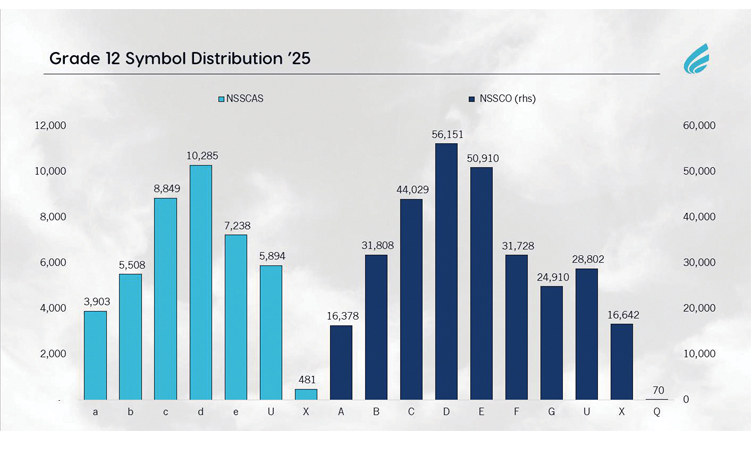
Attainment data points to the same weaknesses. Between 2021 and 2025, the highest average share of grades on the Ordinary level was at the D and E grades (18.7%), followed by C (13.7%) and F (11.7%).
Among Advanced Subsidiary pupils, the most common grade was D (24.5%), followed by C (21.7%) and E (17.8%).
At the higher end, Advanced Subsidiary pupils outperformed those at Ordinary level, recording a greater share of A grades (7.0% against 4.6%) and B grades (13.4% against 8.5%).
Continued reform is necessary if the Namibian school system is to develop.
Many schools still lack the basic resources needed for a conducive learning environment, including sufficient secondary school teachers, classrooms, textbooks, hostels, computers and laboratory equipment.
If results are to improve, education funding must shift its focus from personnel expenditure towards the development of the schools themselves.