



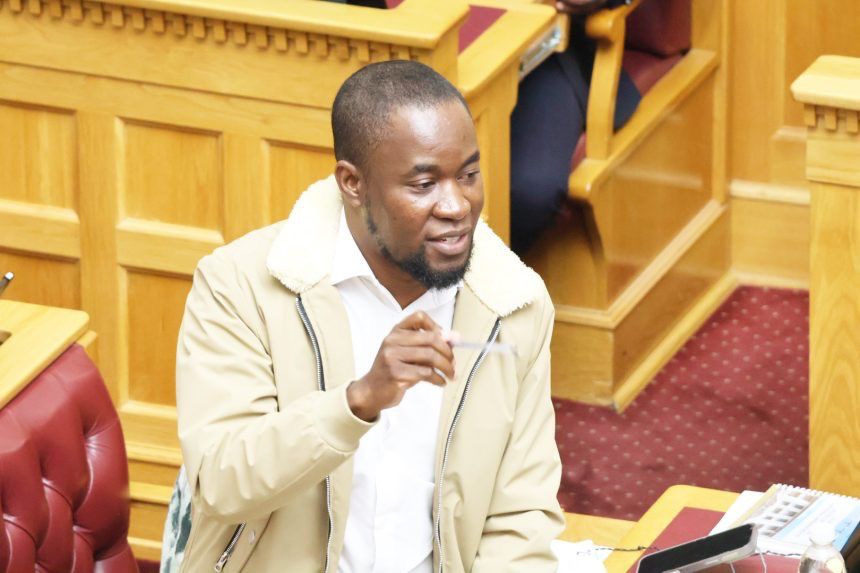
Affirmative Repositioning leader and member of parliament Job Amupanda has given acting agriculture minister Charles Mubita seven days to explain why the government imposed nationwide livestock movement restrictions.
This follows the detection of foot-and-mouth disease (FMD) on a commercial farm in the ||Kharas region.
Through his lawyers, Kadhila Amoomo Legal Practitioners, Amupanda warns that failure to provide a written response could result in further action, including an urgent court application or the matter being raised in parliament.
Mubita announced the outbreak of FMD on Wednesday.
In a letter to Mubita, Amupanda’s lawyers acknowledge the seriousness of FMD and the government’s responsibility to protect animal health.
However, he questions why the restrictions apply across the country when the disease was detected on one commercial farm at Karasburg.
Amupanda’s lawyers argue that areas north of the veterinary cordon fence, commonly known as the redline, have not been affected by the outbreak.
“It is, therefore, not self-evident why communities, farmers and livestock owners in the entire protection zone, hundreds of kilometres from the affected farm, must bear the full brunt of nationwide restrictions,” the letter reads.
Amupanda wants Mubita to explain whether applying the same restrictions north and south of the redline makes the veterinary boundary irrelevant for the current outbreak.
He also wants the ministry to identify the provisions of the Animal Health Act of 2011 and related regulations that allow it to impose nationwide restrictions instead of limiting controls to the affected area.
The letter asks whether a formal state of emergency or a similar declaration has been made. It also asks whether the government carried out a legal review, risk assessment or proportionality analysis before imposing the restrictions.
Amupanda wants to know why the government has not considered declaring Karasburg and its surrounding areas a containment or infected zone.
He argues that this could allow livestock movement and marketing to continue in unaffected areas under controlled conditions.
Amupanda wants to know whether they apply only to commercial activities such as livestock sales, auctions, exports and abattoir slaughter, or whether they also cover animals moved or slaughtered for household consumption, funerals, weddings and other traditional ceremonies.
He wants clarity on whether people can transport meat and milk products between households, towns and regions for family consumption.
Amupanda also wants the ministry to disclose whether it has assessed the financial impact on farmers, communal livestock owners, butchers, abattoirs, transporters and exporters.
“Will compensation be paid to the owner of the affected farm for the animals that may be destroyed or quarantined, and under which statutory provision?”
Amupanda is seeking clarity on how long the nationwide restrictions are expected to remain in place and what conditions must be met before they are relaxed or lifted.
He wants the ministry to consider a zonal approach that would allow restrictions to be lifted in unaffected areas before they are lifted in the affected zone.