





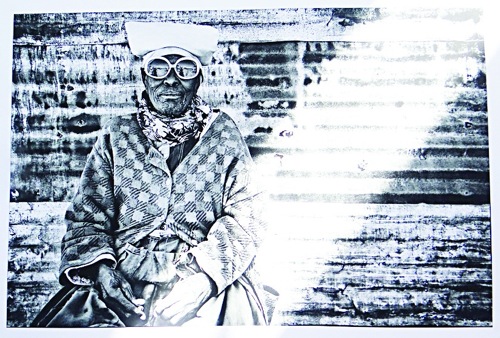
Walking in, there are faces. Three large black and white faces of an old Herero woman, a softly smiling Himba boy and a man around middle age. Depicting youth, the in-between and the aged, the collection of black and white photographs in the entry way of Elyane and Cedric Jacquet’s ‘Namibia, Land of Extremes’ are nothing like the rest of the exhibition in terms of colour and seem a black and white portal to an exhibition filled with light as well as bright and boundless colour.
Just behind these beautiful black and white portraits are full colour compositions of the Himba at home in their natural haunt. Capturing the rarely seen Himba man who busies himself milking a cow, a Himba woman walking with a meal pot and another bent over a fire with her hut in the background, the trio of photographs conjure the romance of pastoral paintings while introducing the Jacquets’ strength.
Though the subject matter is the usual Namibian fare that stuns tourists and photographers from all over the world, the Jacquets’ photographs arrest the eye due to composition.
Capturing the magic of light and shadows, grass and sky and often using animals as accents, the Jacquets’ photographs are beautiful to behold despite showcasing what one has seen a million times over.
Landscapes, wildlife, indigenous people.
For the Jacquets, the beauty of Namibia exists on a grand scale.
Yes, they do zoom in on the wisdom and beauty of an old Herero woman and the innocence of an African child but they also step far away to capture an oryx peaking its head out of low grass under an immense sky or a gathering of flamingos clustered at the bottom of a frame dwarfed by the sheer size of the heavens.
Whether they are picturing animals, landscapes or people, each frame is wonderfully balanced and accented. Nothing is superfluous and everything is in its place.
This is particularly true in an incredible photograph titled ‘Storm’ in which the photographers arrest a pink and purple sky spitting lightning over dark mountains and green ground. Their frames are simply wonderful and the exhibition adds an element of delight when animals are enlarged and the main subject of the scene.
Featuring close ups of chameleons, a squirrel and a scaly pangolin who seem proud, curious and shy respectively, the Jacquets introduce the odd inclusion of animal portraiture. This can also be seen in their ‘After the Rain’ series in which birds walk the waterlogged earth after a deluge. One bird stands and surveys, the other looks down apprehensively and the last fairly frolics in a series of photographs enhanced by shining light and water.
Though the Jacquets do not often zoom in on plant life in the exhibition, they do in ‘Death Vlei’ which depicts cracked earth that sprouts a split tree made of wood and sunlight.
Always striking, wonderfully composed and with great big canvases to suck you in, ‘Namibia, Land of Extremes’ is nothing you have never seen before but everything you wouldn’t mind seeing again. Executed immaculately.
‘Namibia Land of Extremes’ is on display at the Franco-Namibian Cultural Centre.