The Namibia Informal Settlements report exposed the damning conditions in which Namibians in informal settlements live.
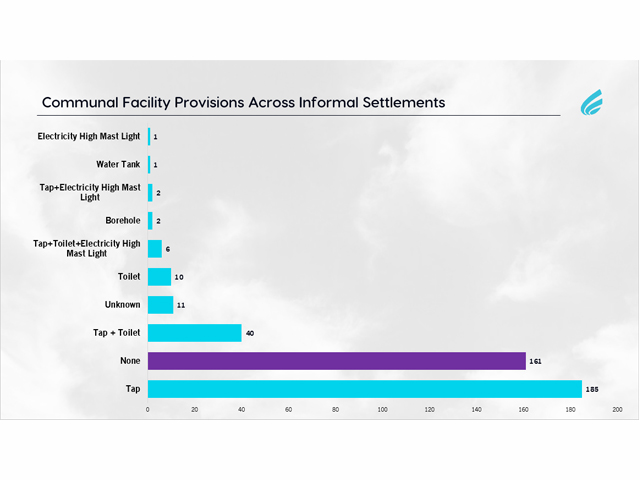
Of the 419 informal settlements surveyed, 38% had no communal or publicly shared facilities recorded.
These settlements house some of Namibia’s most vulnerable people, and communal services are vital for providing access to basic facilities.
This severe lack of access is worsened by the fact that 60% of the settlements are categorised as congested, meaning a low supply of services must serve communities with a high volume of residents.
Beyond communal facilities, formal bulk infrastructure is largely absent: 93% of settlements have no roads, 86% have no sewerage, 70% have no bulk water supply and 70% have no electricity network.
These figures measure large-scale reticulated services rather than the shared taps and toilets counted as communal facilities, so a settlement recorded as having no bulk water may still rely on a communal tap for interim access.
The overall picture is nonetheless one of widespread unserviced land.
Windhoek is the worst affected: all 150 of its informal settlements are classified as lacking formal bulk services, making the capital alone responsible for roughly 61% of the country’s unserviced informal settlements.