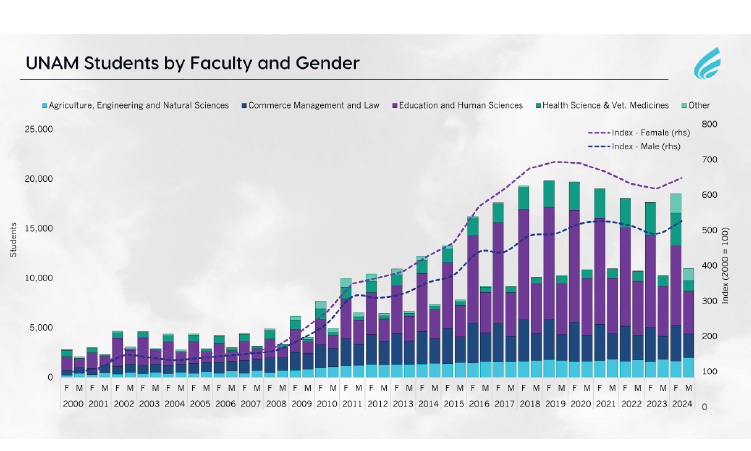
University of Namibia enrolment has grown strongly over the last two decades, rising from less than 5 000 students in 2000 to just under 30 000 in 2024, a six-fold increase.
Enrolment growth was especially strong between 2009 and 2020, rising to a peak of 30 577 students. Since then, enrolment has eased slightly, although 2024 still sits well above the levels recorded prior to 2016.
A notable point is that female enrolment has consistently been higher than male enrolment throughout the period and in the majority of faculties.
In 2000, women accounted for 57.7% of total enrolment. By 2024, that figure had risen to 62.7%.
Education and human sciences remains the largest faculty by a clear margin, and in 2024 it accounted for 42% of total enrolment. Commerce, management and law was the second-largest faculty, with 5 937 students, or 20.1% of total enrolment.
Health science and veterinary medicine has shown one of the strongest and most consistent increases, with enrolment rising from 770 students in 2000 to over 4 300 in 2024.
It is also the most female-dominated faculty, with women making up 75.7% of enrolment in 2024. The only male-dominated faculty is agriculture, engineering and natural sciences, which grew to 3 670 students in 2024, with men making up around 54.1%.
Enrolment appears to have declined after the Covid-19 pandemic, with the decline driven by lower enrolment in education, while health sciences, agriculture, engineering and natural sciences have held up relatively well.
Namibia spends a lot on education as a percentage of overall gross domestic product, and despite graduate numbers consistently improving, finding a job after education is becoming almost impossible.
The criteria for a successful education system should not be how many students go through the system, but how many go on to become functioning, useful members of society. And on that metric, Namibia falls well short.
– Oliver Diggle is an economist at Cirrus Capital.