



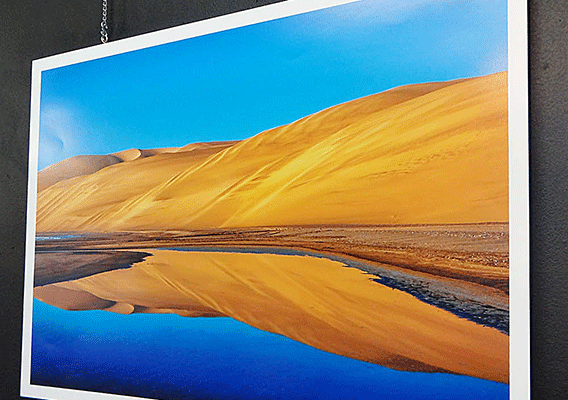
Ask photographers what’s particularly wonderful about Namibia and soon they’ll mention the light. How there are more than 300 days a year just filled with it and that it seems to gift all that it touches with a singular glow.
In ‘Namibia by Namibian Photographers’, a collective photography exhibition currently on show at the Franco-Namibian Cultural Centre, a mix of amateur and professional photographers have ensnared the light.
Surreal in Hennie Lacock’s bare tree below pink clouds, dreamy in Andre de Jager’s reflecting scene during an obscure and magic hour and soft in Maja Carstens silhouette filled wagon amidst a long orange-toned journey, the exhibition is one in which 15 photographers present two images apiece speaking of Namibia’s beauty through personal photographic style.
Responding to the sole imposed criteria that photographs must have been taken in the country, each photographer had the freedom to go wild and many of them did.
Jennie Lates whose black and white pelicans floating on glistening water joined the exhibitions flock of birds including those blue or desaturated by Christopher F Joubert Claasen. Olivier Fabien who stills a herd of oryx making their way through a contrasting desert landscape and Elaine Rossillon with her trio of meerkats framed by delicate leaves just a few frames from a similarly fringed elephant by Oili Carstens.
A celebration of the local wildlife by Francoise Vallet, Pascal Supply, Stacey Hookins, Chrissi van Dyk, Andre de Jager and Ute von Ludwiger, the exhibition also features portraits of people by Helge Schulz and Xenia Ivanoff-Erb. The former capturing a star spangled swimmer amidst a great gulp of air while the latter halts the run of a little boy pushing a wire car.
Dominated by admirable animal photography depicting teeth baring domestic disputes between lions, the orange intensity of a wolfish stare and the tenderness of a snow white deer, the exhibition is equally impressive in images of landscapes by Emmanuel Bonnin as well as Antonio Orfao who captures water like lava while Johan Jooste’s lens considers the miracle of the ocean meeting the desert.
A respectable visual art outing that is not as well curated as the images deserve and strangely scant on photographers of colour in a country where the majority of Namibians are, in fact, black, ‘Namibia by Namibian Photographers’ would have benefited from the improved range of inclusivity (enter Vilho Nuumbala, Lukas Amakali, Papa Shikongeni, Julia Hango, Merja Iileka, Kevin Perestrelo et al) and the basic task of naming and situating the scenes.
Entirely devoid of the when and where, the exhibition is mute on where one can experience the sights while resplendent birds flit anonymously in the frames.
Described by the FNCC as a response to “a society where more and more photographs are available online, consumed at an accelerated pace, to the sound of the click of a mouse, forgetting the previous one”, the exhibition is on show because “it felt important to give these photographers a platform to express their love for Namibia.”