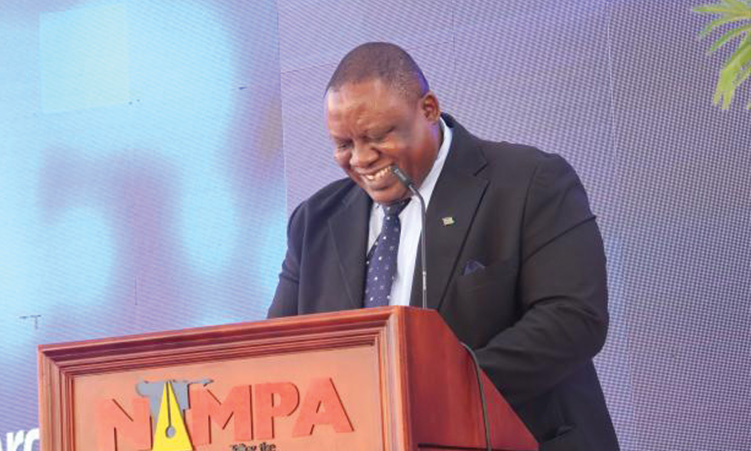
BUSINESSMAN Titus Nakuumba faces an uphill battle to keep several controversial mega deals he struck with the government over the past few years.
Born in Oshakati but raised in Swakopmund, Nakuumba became a beneficiary of state contracts worth over N$1 billion.
He has four public private partnership deals with state institutions but the future of three of those hangs in the balance after a government decision to put them on hold.
A public private partnership deal is a contract between the government and a private party which takes over a public service and assumes the financial, technical and operational risk of the project.
Deals linked to Nakuumba include a contract under the mass housing project, the TransNamib property deal and the 45-hectare deal near Rocky Crest suburb, which he struck with the Windhoek municipality.
The businessman spoke to The Namibian last month about his involvement in several multi-million dollar deals and admitted that he is in the dark about the future of some of the deals.HOUSING
Nakuumba uses Afrikuumba, a company he co-owns with his father Lukas and Afrideka, a company founded by Johann de Beer in 1972 as vehicles for securing PPP deals.
Afrikuumba is a beneficiary of a N$350 million mass housing contract received through a joint venture with CalgroKuumba.
The mass housing programme was however suspended about a month ago with Nakuumba owed around N$50 million by the state for work on the project.
Although Nakuumba is brother-in-law to the outgoing National Housing Enterprise chief executive officer, Vinson Hailulu, and there are suspicions that he landed the contracts because of this relationship, Nakuumba says the two are not on talking terms.
He however admitted that NHE under his brother-in-law had initially awarded Afrikuumba a mass housing project in Otavi but later changed that to the lucrative Windhoek contract after South African company, Calgro came to Namibia looking for joint venture partners.
The Namibian understands that NHE top officials travelled to South Africa before the mass housing project was implemented. This raised suspicions that the officials possibly hand-picked Namibian companies to partner South African firms before awarding the joint ventures multi-million-dollar contracts.
Nakuumba could not explain how his company was selected for a joint venture with Calgro.
Housing units built by Nakuumba have been criticised as being too small with some people branding them apartments with little space for expansion. Nakuumba however maintains that the design he uses on the project is modern unlike NHE houses of the 1980s.
He said the prices of NHE houses are high because “they design (houses on) a 300-400 square metre yard. Are you looking for a garden or a house?
The bigger your erf, the more it is going to cost to service”.
Allegations of favouritism do not end there. Nakuumba got a piece of land big enough to build 1 200 low-cost houses adjacent to the site of his mass housing contract in Otjomuise through a public private partnership deal. The entire land in Otjomuise Extension 10, which includes the mass housing project, was serviced with funds from the Targeted Intervention Programme for Employment and Economic Growth (Tipeeg).
“The initial mass housing design was that the land will accommodate over 2 500 houses. NHE wanted to reduce the housing units to 1 200 but we said we can build the extra 1 300 units at our own cost,” he said.
So who qualifies to buy the extra 1 300 houses?
Nakuumba said the additional 1 300 houses would be sold at below NHE prices. The Namibian understands that Nakuumba’s company plans to sell some of the houses under the PPP.
CITY LAND
Besides the mass housing site and the extra land big enough for 1 300 units, Nakuumba is among the well-connected businesspeople who got huge plots from the Windhoek municipality. He got a plot bigger than 50 football fields put together near Rocky Crest suburb.
Documents show that some city executives were against the sale of the 45 hectares to Nakuumba after realising that they had been ripped off by opportunist private developers.
“I am not going to eat the land. We are taking it to develop the city. That area is earmarked for the middle class who want to buy houses worth between N$700 000 and N$1,4 million per unit,” Nakuumba said.
His public private partnership deal with TransNamib was among the contracts that the troubled parastatal clinched in a questionable manner.
That deal raised questions resulting in former transport minister Erkki Nghimtina wanting to terminate it.