






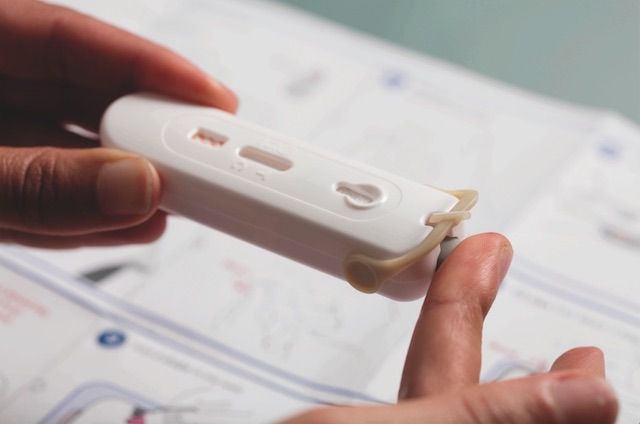
GLOBAL pharmaceutical company Mylan N.V has launched its first HIV self-test kit that is now also available in Namibia as of last month.
The hand-held vitro HIV rapid diagnostic test is designed to detect the presence or absence of HIV antibodies in a single drop of blood through a “finger-stick”.
This was announced in a press release last month by the United Kingdom-based pharmaceutical company.
The new and improved test was co-developed by medical device developer Atomo Diagnostics. Mylan announced a partnership with Atomo Diagnostics in September last year.
More than 100 countries across Africa, Asia, the Middle East, the Commonwealth of Independent States (CIS), and Latin America, will have access to this test.
Apart from privacy, people who use the test get their results in 15 minutes.
The Mylan HIV self-test costs around N$136.
It comes with the test kit, instructions, a bottle of test fluid, a discreet disposal bag and a care card, which is used by users to keep record of their result.
The pharmaceutical company in the statement said the purpose of the rapid diagnostic test is to promote early treatment.
The development and distribution of the Mylan HIV self-test was largely driven by inadequate access to self-tests in low and middle-income countries like Namibia.
“While in some countries like the United States and in Europe, HIV self-tests are readily available in pharmacies, HIV testing in low and middle-income countries remains dependent on the diagnostic test being conducted in formal settings by professionals,” it stated.
The statement added that a test such as this one aims to mitigate challenges such as patients being “hard to reach” or socially isolated due to stigma and discrimination.
“The sooner an individual is tested, the sooner counselling can be offered, and prevention options or treatment can be initiated, which is critical to halting further transmission of the virus,” it stated.
The World Health Organisation (WHO) defines HIV self-testing as a process in which a person collects his or her own specimen (either oral fluid – saliva, or blood from a finger prick), then performs a rapid HIV test and interprets the results.
Rapid HIV tests used for self-testing detect HIV antibodies, which are produced by a person’s body when he or she acquires an HIV infection.
However, HIV tests cannot detect HIV infection immediately after exposure. There is a “window period” of one to three months after exposure before HIV antibodies can be detected, WHO explains.
“If the result is positive, the person seeks retesting at a facility to confirm this result or not,” the information sheet states.
If the result of the self-test is negative, WHO states that no further action is necessary unless the person has had a recent likely HIV exposure or faces ongoing high risk of HIV infection.
A WHO HIV self-testing fact sheet stated that 77 countries have adopted HIV self-testing policies, while others are currently developing them.
It noted that 81% of people on antiretroviral treatment achieve viral suppression.
In Namibia, WHO estimated that 190 000 individuals aged 15 years and older, are living with HIV and in 2018, 5 700 new HIV cases were diagnosed among adults aged 15 years and older.
According to a Unaids HIV Global Statistics Fact Sheet for 2019, about 8,1 million people worldwide did not know that they were living with HIV. However new HIV infections have been reduced by 40% since the peak in 1997.
The Mylan HIV self test received pre-qualification approval by the World Health Organisation this year.
The WHO pre-qualification (PQ) aims to ensure that diagnostics, medicines, vaccines, and immunisation-related equipment and devices for high burden diseases meet global standards of quality, safety and efficacy to optimise the use of health resources and improve health outcomes. The PQ process consists of a transparent, scientifically sound assessment, which includes dossier review, consistency testing or performance evaluation, and site visits to manufacturers.
Executive director of the Desmond Tutu HIV Foundation Linda-Gail Bekker said HIV self-testing is a “game-changer” in helping countries meet the UNAIDS 90-90-90 targets, which states that 90% of all HIV positive people know their status by 2020.
By having more high-quality and user-friendly HIV self-tests widely available like the Mylan HIV self-test, makes it a powerful tool in expanding diagnosis and treatment of vulnerable and previously untested populations.