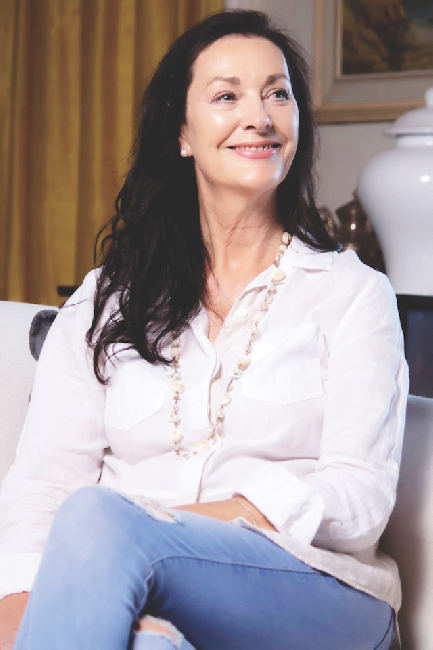
However, pageants were not all smooth sailing some years back. The Weekender recently spoke to Desèré Lundon-Muller, who as Desèré Kotze was Miss Namibia 1982.Lundon-Muller, a partner and marketing manager of the Namibia Economist, shares some insights on her year as Miss Namibia.Lundon-Muller is a paradigm shifter and a visionary leader – she's been supporting influencers for more than two decades and continues to be dedicated to supporting and empowering women to bring all of themselves to the world wholeheartedly.As a notable women's empowerment advocate and coach, she has delivered business-building and training platforms such as the Namibian Businesswoman of the Year Awards, the Katuka Mentorship Programme, the Economist Businesswomen Networking Breakfasts, and the Northern Businesswomen Conference. Her comprehensive programmes have served hundreds of businesswomen and entrepreneurs annually.She is a single mother of three children, aged 24, 33 and 35.It was actually eight years before the country'sindependence when Lundon-Muller, a sparkly 18-year-old Stellenbosch University second-year student, became the third Miss Namibia. The then Desèré Kotze followed in the pioneering footsteps of Bernice Tembu, the first Miss Namibia in 1980 and Antoinette Knoetze, the second.Lundon-Muller says it was a time when political perceptions determined the international community's focus on South Africa's occupation of the territory known as South West Africa. Reflecting of her reign, she says it proved to be a baptism by fire for her.She reflects on a time when, as she put it, everything was ruled by politics.“The Miss Namibia pageant was started by the Republikein newspaper in 1980, in defiance of South Africa which still had a stranglehold over all domestic affairs. The Miss Namibia pageant brought immense exposure at that time for a country that was still unsure about its future. It also added to the complexity of being allowed to participate in the Miss Universe pageant, where the political heat was even more intense,” Lundon-Muller says.She says she was eventually allowed to represent Namibia as an independent country. She travelled to Peru, where she spent a month as a participant in the 31st Miss Universe pageant, held in Lima. Seventy-seven contestants competed and Karen Dianne Baldwin of Canada scooped the crown.“When we entered for Miss Universe they at first did not accept my entry, but later informed us that I can now enter. It was not easy at that stage because there was a lot of politics involved. Namibia was not independent yet,” she says.Lundon-Muller recalls that participating in international pageants at that time was challenging because there were hardly any support systems in place.“Other winners come with a team and I was alone. They had hairstylists, make-up artists and a huge wardrobe. I only had two evening dresses.“There was no money for pageants in those years. I arrived in Lima as a student with only two evening gowns in my bag.“Every day we had to attend formal functions and every evening there was a different ball at a different venue. It was crisis management in the extreme and I had to mix and match to make it appear my wardrobe was sufficient.“Yes, there were some very special moments. For instance, I had a gorgeous full-length karakul coat which I loved to wear as a substitute symbol, reflecting the pride of Namibia's agriculture-based society,” she says.At the main event, in the absence of Namibian national symbols, she had to make do with a South African flag, which created a tense moment when the world's TV channels crucified her. “Pageants outside Namibia did not welcome us and at Miss Universe we were told beforehand that we won't make it to the finals or win. When I entered I knew actually what I was getting myself into. I had to prepare myself physically and emotionally,” she says. Two years later the Miss Universe organisers did not allow Namibians to participate any longer, because there was not a national flag yet, Lundon-Muller says.She adds that pageant contestants back then needed to know a lot about their country and its political conditions because journalists and judges would ask only such questions.She recalls that she was also beset by the international press – all wanting to know her views on independence and on South Africa's occupation.“It was not only the Peruvian press, but the whole world's media was there. You dared not even bend down to fasten your shoe, or you saw yourself on front pages the next morning,” she says.As part of her year as Miss Namibia, she had to attend to many formalities – attending school gatherings, addressing students at universities and being an excellent role model for other aspiring youngsters. This experience has left an indelible mark, she says. Lundon-Muller has now ventured into marketing. She says her main aim with working in this field is to help make a difference.She says growing up, women found it difficult to make it. During her year as Miss Namibia she realised that women were disadvantaged and she resolved to change this.“For a women it was challenging to reach management positions. Women were discouraged to have a career and those who made one found it difficult to get a husband. I wanted to motivate and bring change.“As a result of my struggles in a male-dominant working environment, the idea of the Economist Businesswomen Club was born. In 1997, the organisation was launched. I have followed this dream of mine and today it is having a tremendous impact on the lives and advancement of other women through the projects I run for the Economist Businesswoman Association,” she says.Despite the challenges she has faced, Lundon-Muller says her year as the title holder was indeed one of the most beautiful and inspiration moments in her life.“I was pushed beyond my own borders. Today, I have a better idea of who I really am and what I can do. I will forever be humbled for meeting amazing people and being exposed to difference cultures,” Lundon-Muller says.