



• JACQUELINE L SCOTTSometimes a hat is just a hat. But not when it’;s a pith helmet worn by a white politician visiting Africa.
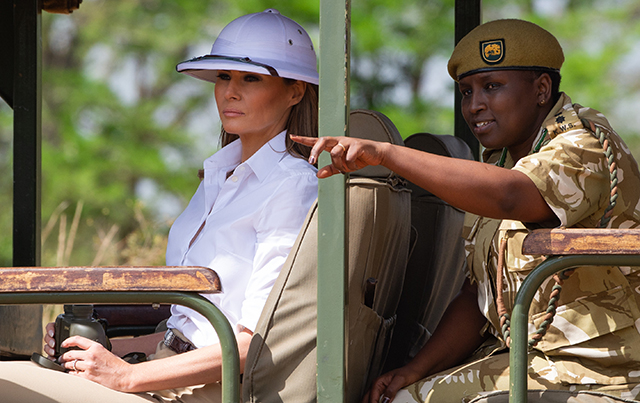
Pith helmets are relics of colonialism and its big game hunting tradition. So why would Melania Trump wear one?
On a solo tour of Africa, the United States first lady stopped in Ghana, Kenya, Malawi and Egypt. She went on safari.
The pictures of her in a pith helmet and looking rather inscrutable went around the world. Although the first lady said “I want to talk about my trip, not what I wear”, it is impossible to not talk about the ways race and space collide in this image.
This, of course, is not the first time Trump has been challenged on her clothing choices. After she wore a jacket that said ‘;I really don’;t care, do u?’; while en route to an immigrant child detention centre, many claimed her choice of clothing was carefully scripted.
Safari is a multi-million dollar industry in Africa.
It is most often talked about in terms of tourism, conservation, poaching and big game hunting. Let’;s add race to that mix.
Most safari tourists, like Melania Trump, are white. The people driving them around, carrying their bags and doing their cooking are mostly black.
Visually, not much has changed since the colonial days of explorers and big-game hunters in Africa.
In the old days, white people had the guns and wore the pith helmets. Trump’;s choice of headgear continues that tradition.
Trump has another link to colonial big game hunting. Six years ago, her stepsons – Eric and Donald Trump Jr – bagged an elephant, leopard and water buffalo on their African hunting safari.
At the time, the Trump men argued that it was a legal trophy hunt and that trophy hunting like theirs provides funds to help communities with conservation.
For example, this summer a white woman from Kentucky, Tess Thompson Talley, killed a giraffe in South Africa.
Was the dead animal sprawled at her feet a testament to her prowess as a hunter who’;s comfortable in the bush and knows her way around a gun?
Talley said her hunt was legal and that the money she spends “hunting in Africa goes towards local wildlife preservation”.
The trouble is the line between legal and illegal becomes blurred when dollars, pounds and euros are at stake.
Let’;s not forget Cecil the Lion, when the legal lines are more clear.
In 2015, Cecil was lured and killed outside of a protected conservation park by Minnesota dentist and avid trophy hunter Walter Palmer.
These are some infamous examples of American trophy hunters.
Their main competitors in the African safari kills are the aBritish and Germans. A German hunter legally killed one of the largest elephants in Zimbabwe in October 2015.
Big game hunters like to pose with their kill on social media. These kill shots are popular. It’;s a way of bragging that the hunter was rich enough to go to Africa to hunt. In this context, it becomes just another version of conspicuous consumption.
Black people are rarely featured in these kill shots, and when they are, they don’;t have the guns. Those are in the hands of white people.
To me it’;s the same old story that has nothing to do with conservation; it is race, power and privilege on display.
Trophy hunting is just one factor driving the extinction of rhinos and elephants in Africa. Poaching is the bigger issue. Race and the history of colonialism are factors here too.
African animal parts are used in traditional medicines to cure a whole range of supposed ailments. The cures do not stand up to modern medicine. The rotting carcasses littering the African landscape seems to be a small price for a dubious elixir.
African governments are complicit in not enforcing anti-poaching laws. While this is true, it also ignores the legacy of colonial economics in Africa.
In an age of information overload, Sunrise is The Namibian’s morning briefing, delivered at 6h00 from Monday to Friday. It offers a curated rundown of the most important stories from the past 24 hours – occasionally with a light, witty touch. It’s an essential way to stay informed. Subscribe and join our newsletter community.

The Namibian uses AI tools to assist with improved quality, accuracy and efficiency, while maintaining editorial oversight and journalistic integrity.
Stay informed with The Namibian – your source for credible journalism. Get in-depth reporting and opinions for
only N$85 a month. Invest in journalism, invest in democracy –
Subscribe Now!