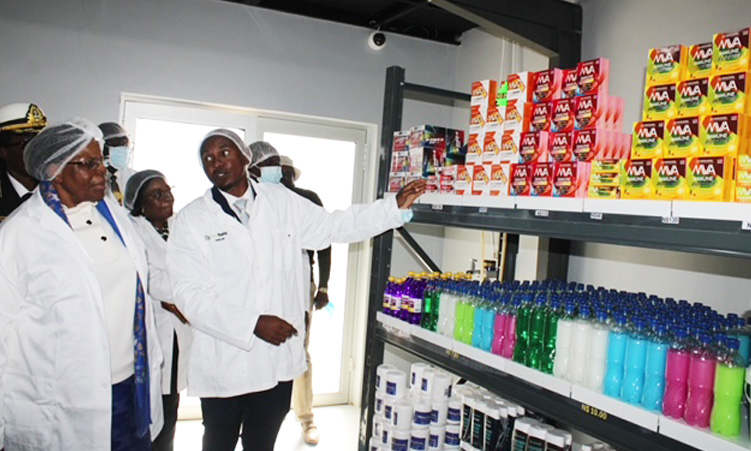
President Netumbo Nandi-Ndaitwah says reports of medicine shortages at public hospitals are giving her “sleepless nights”.
She was speaking during a tour of the pharmaceutical manufacturing company Fabupharm at Otjiwarongo yesterday, where she engaged with the company’s management and health officials on local medicine production.
“If there’s one thing that gives me sleepless nights, it’s when I’m hearing there is no medicine at our hospitals,” Nandi-Ndaitwah said.
These concerns come amid mounting criticism from medical doctors, who say shortages of essential medicine continue despite government reports indicating that national stock levels stand at about 60%.
Doctors who spoke on condition of anonymity for fear of victimisation this week told The Namibian patients are still being turned away or left without treatment at several hospitals.
The president said the government remains committed to ensuring all Namibians have access to quality healthcare services.
“Our government, under my leadership, we are determined, we are committed to see how best all Namibians can get access to quality health services,” she said.
Nandi-Ndaitwah said the government’s commitment to healthcare is driven by the belief that “a healthy nation is a productive nation”.
“And a productive nation is the only nation that can bring about prosperity,” she said.
The president said productivity should not only be associated with factory or farm work, but also with innovation and research.
“Everything starts with research. In the research, you are using your brain, and that is really what we want to see,” she said.
She highlighted challenges faced by communities in remote areas to access healthcare services.
Nandi-Ndaitwah said all stakeholders need to work together to improve healthcare services in the country.
Executive director of health and social services Penda Ithindi at the occasion said Fabupharm could help reduce long lead times for essential medicines and strengthen the country’s medicine supply chain.
He suggested that Fabupharm’s partnerships with international companies could allow for the introduction of more pharmaceutical product lines relevant to both Namibia and neighbouring countries.
“So, is it possible through international partners that you introduce more lines here of more products, high-end products that are more relevant to the domestic market?” Ithindi asked.
Fabupharm is Namibia’s largest pharmaceutical manufacturing company and has announced plans to expand its production capacity and laboratory infrastructure over the next five years.
Fabupharm founder Fanie Badenhorst during the tour reflected on the company’s early development, saying the business was born out of practical experience in retail pharmacy and a growing need for local pharmaceutical manufacturing.
“In 1986, while operating a retail pharmacy in Otjiwarongo, I reached a professional turning point and realised that the retail sector offered few new challenges beyond financial and business growth,” Badenhorst said.
He said he began compounding essential products such as aqueous creams during periods of wholesale shortages, which exposed gaps in domestic supply.
“This experience highlighted a critical gap in the local market – the need for domestic production,” he said.
Badenhorst said this has led him to pursue advanced studies in industrial pharmacy, in consultation with the dean of the faculty of pharmaceutics at North-West University.
“Driven by this need … I committed to full-time advanced research in 1987,” he said.
He said by the end of 1989 he had completed an honours B Pharm degree and a master of science degree in industrial pharmacy, during which time Fabupharm Products (Pty) Ltd was registered in Windhoek.
Initial medicinal product dossiers were submitted to the Medicines Control Council, he said.
Badenhorst said in 1990, coinciding with Namibia’s independence, he returned to Otjiwarongo to begin manufacturing toiletries tailored to the local market.
By 1992, the company had acquired land at the town’s industrial area to build a dedicated pharmaceutical manufacturing plant designed for creams, syrups, suspensions and ointments.