The Namibian beef industry requires investments in new infrastructure like feedlots, equipment and drought-restocking schemes to boost productivity in the sector.
This recommendation was made by economic researchers High Economic Intelligence (HEI), in a beef industry update for June.
The report also called for the provision of incentives to small-scale beef processors to support their operations, prioritisation of the enhancement of rangelands and grazing capacity for cattle, along with initiatives to produce and store animal feed for use during times of drought.
The researchers say because beef production is the backbone of Namibia’s agricultural sector, effective national and transboundary vaccination programmes and disease control measures are needed to safeguard the health of the cattle population.
“Modernising farming practices and encouraging the adoption of modern agricultural techniques, including improved breeding, feed management and herd management to increase productivity and produce higher-quality beef, investment in research and development to promote advancements in cattle genetics, nutrition, and health, are also highly recommended,” said the report issued by economist Turimuye Uandara.
This can lead to the development of more productive and disease-resistant cattle breeds and better feeding strategies, foster collaboration among industry stakeholders, including farmers, processors, researchers and policymakers, Uandara said.
“This will also encourage knowledge sharing, technology transfer, and the exchange of best practices for continuous improvement and innovation within the beef industry,” she said.
The HEI report said cattle marketing showed growth during 2022 compared to 2021, and this upward trend is expected to continue throughout 2023.
“However, climate change, rising input costs and animal diseases remain significant risks to the industry’s outlook for 2023 and beyond,” said the report, adding that addressing these challenges would be crucial for the sustainable growth and development of the beef industry.
According to HEI researchers, the agriculture sector contributes significantly to the country’s gross domestic product (GDP).
Over the past nine years, the sector contributed an average of 4,8% to the GDP, with the livestock farming subsector (mostly cattle and sheep) contributing about 2,9% on average.
Additionally, the beef industry contributes about 70% to the country’s agricultural GDP, said the report.
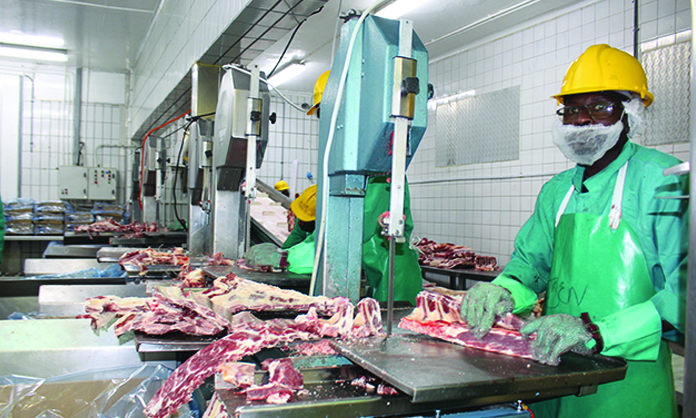
During the third quarter of 2022, Namibia exported meat and meat products valued at N$420,7 million, of which beef accounted for 40,5% of these exports, said HEI.
The researchers said between 2010 and 2022, Namibia marketed a total of 4 432 695 cattle, of which 1 718 289 were slaughtered, and 2 712 380 were exported live, mainly to South Africa.
“Out of the total cattle slaughtered during this period, 1 328 625 were for export, while 390 165 was for the domestic market,” said HEI.
The researchers said cattle marketing for 2012, 2014, 2016, 2020 and 2021 declined significantly as farmers were restocking to recover from the losses incurred during the drought seasons.
However, the number of cattle marketed in 2022 increased by 2,33% compared to 2021, with Namibia marketing a total of 240 463 cattle in 2022, compared to 234 984 cattle marketed in 2021.
The growth was attributed to relatively good prices at export abattoirs. Out of the total cattle marketed for 2022, only 100 850 cattle were slaughtered.
The researchers said of these, 30 282 were slaughtered by the south and northern veterinary cordon fence butchers for the local market, and 70 586 cattle were slaughtered by the export abattoirs (Meatco, Beefcor, Hartlief, and Zamcor) for the international market.
A total of 139 613 cattle were exported live. South Africa took up the largest share of 99% at a standard value of N$9 498 per head.
During 2022, Namibia exported 10 020 827 kg of beef, with the European Union the main destination accounting for 46%, followed by South Africa with 20%, while Norway and China accounted for 13% each, the report said.
– email: matthew@nasmibisn.com.na