NAMIBIA lags behind other developing countries and emerging markets in recovering from the lockdown-induced recession, indicative of long entrenched economic challenges, as well as a lack of policy and structural reforms since 2015.
According to a Simonis Storm analysis released on Monday, the country is likely to continue lagging behind these countries with into 2022.
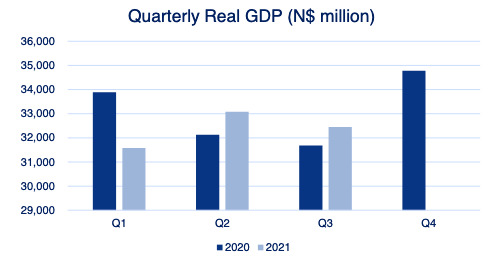
GDP figures for 2021 so far paint a better picture than initially anticipated, with the economy contracting by 6,8% in the first quarter of 2021 but growing at a revised 3,0% in the second and 2,4% in the third.
“Excluding the fourth quarter, the economy contracted by 0,5% in 2021. With the third quarter of 2020 being the lowest base to lift off from, we believe the 2,4% third quarter GDP figure is likely to be revised upwards,” said Simonis.
“Sectors we expect to have contributed positively to the fourth quarter 2021 GDP print include ICT, tourism, mining, agriculture and utilities.
An average of local GDP forecasts of an annual growth of 1,4%, implying that the fourth quarter of 2021 needs to record an unlikely 7,1% GDP growth,” said the report.
BELOW EXPECTATIONS
Despite good rainfall being received in different parts of Namibia, heavy rains flooded certain fields in Zambezi and continued heavy rainfall will be detrimental to crop production in 2022.
Between January and November 2021, cattle production decreased by 3,9%, sheep (-25,3%), goats (-1,2%) and pigs (-0,3%), compared to the same period in 2020.
“Given that livestock accounts for about two thirds of the agricultural sector and based on the latest performance, we expect livestock to weigh down on total agricultural production,” said Simonis.
Despite lower local cattle production, beef exports increased by 15,8% on a quarterly basis in November 2021, as a result of increased live cattle imports from Botswana.
Top beef export destinations included South Africa (28%), the European Union (27%) and Norway (26%). China was the third largest export destination in 2020.
DOUBLE DIGIT RECOVERY
Occupancy rates at lodges, hotels, bed and breakfasts and campsites across the country edged higher towards the end of the year.
Occupancy rates stood at about 12% in July, 27% in August, 27% in September and 34% in October 2021.
Most guests at nationwide establishments originated from Europe in October 2021 and constituted 47%, while locals made up 38%.
While occupancy rates are double 2020 levels, they remain about half of October 2019’s levels of about 70%.
On average, Namibia has received more regional travellers than foreigners since the pandemic outbreak.
Pre-pandemic, Hosea Kutako International Airport (HKIA) received 3 148 regional travellers per month, compared to a post-pandemic figure of 339 per month on average.
For foreign tourists, the numbers changed from 18 341 on average per month to 2 654.
Following a 10,4% contraction in the first quarter of 2021, GDP figures for the hotels and restaurants sector recorded double digit growth of 34,3% and 19,5% in the second and third quarter, respectively.
“When the Omicron variant struck, travel from certain countries to Namibia was banned during December 2021, which saw a limited number of tourists arriving at HKIA.
“With key countries such as Germany requiring travellers to quarantine upon return arrival, we believe the number of tourists visiting Namibia was further constrained.
“However, we remain confident that the tourism sector would have performed significantly better compared to 2020’s fourth quarter,” said Simonis.
MARGINAL GROWTH
During the fourth quarter of 2021, the NSA alcoholic beverage production index increased by 16,6% and 5,7% in October and November 2021, respectively, while the production index for non-alcoholic beverages declined by 36,0% and increased by 3,5% in October and November 2021, respectively.
On an annual basis, alcoholic and non-alcoholic beverage production decreased by 8,5% and 13,6% during 2021.
This sub-sector, making up 13% of the manufacturing industry, will weigh on overall 2021 growth in the manufacturing sector.
Lower livestock production will also weigh on meat processing activities, making up 5% of the manufacturing industry.
On the positive side, improved mining production will benefit smelters, mineral processors, refiners and diamond polishers who make up 11% of the manufacturing industry, among others, in the manufacturing sector for the fourth quarter of 2021 and 2022.
In an age of information overload, Sunrise is The Namibian’s morning briefing, delivered at 6h00 from Monday to Friday. It offers a curated rundown of the most important stories from the past 24 hours – occasionally with a light, witty touch. It’s an essential way to stay informed. Subscribe and join our newsletter community.

The Namibian uses AI tools to assist with improved quality, accuracy and efficiency, while maintaining editorial oversight and journalistic integrity.
Stay informed with The Namibian – your source for credible journalism. Get in-depth reporting and opinions for
only N$85 a month. Invest in journalism, invest in democracy –
Subscribe Now!