



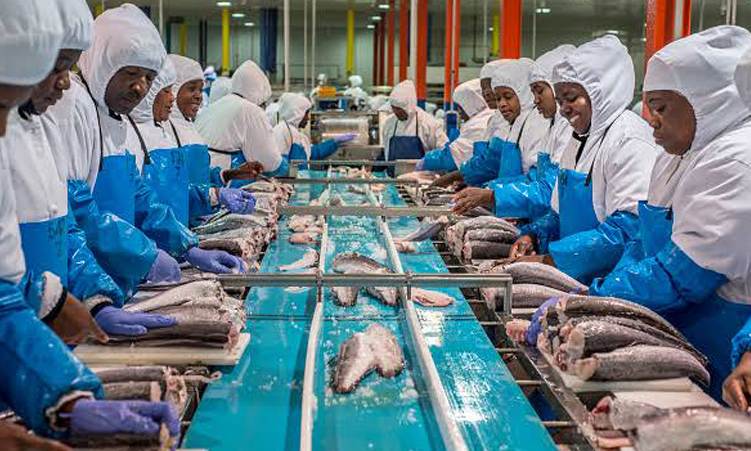
About 300 Marco Fishing employees have been locked out after wage negotiations between the company and the Namibia Food and Allied Workers Union (Nafau) reached a deadlock.
The lockout started on Friday and remains in effect.
Marco chief executive Steven Rajzman says the company cannot meet the union’s demands because average longline hake catches have declined by more than 45% over the past five years, placing its operations under severe financial pressure.
“While Marco Fishing fully respects the rights of employees and organised labour to engage in collective bargaining, these increases cannot be accommodated, and even more so under the current financial realities facing the business,” Rajzman says.
Nafau is demanding a one-year agreement that includes N$800 plus a fish commission for seagoing personnel, resulting in N$1 100, while land-based employees would receive N$27 per hour, in addition to transport, housing and other allowances.
Rajzman says the company has been facing an extended period of severe operational and financial pressure on the longline hake business, driven by sustained poor catches.
He says the decline in average hake catch per shoot by more than 45% has led to the business falling to levels that are no longer financially viable.
Rajzman also attributes the decline to restricted access to historical fishing grounds south of Lüderitz, saying the company had limited access to these areas and was struggling to maintain a commercially viable operation under the current conditions.
He says the company has raised these concerns with the Ministry of Agriculture, Fisheries, Water and Land Reform and has requested relief to fish in shallower waters.
“We have presented our request to the ministry on more than two to three occasions over the years.
However, we have not received any response on what the ministry’s stance is concerning fishing in shallower waters or any other advice on what could serve as a relief for us as a company,” Rajzman says.
The ministry was not reachable by the time of going to print.
Nafau ||Kharas regional coordinator Simon Mattheus says the initial proposal of the union was an increase of N$2 000 for seagoing personnel whose current basic salary is N$4 000.
Mattheus says the company came up with a three-year phased agreement of giving 4.5% in year one, 5% in year two and 5% in year three.
“Meaning the employees will only receive N$800 on top of N$4 000 in three years time, which is not in the best interest of the employees. We want this to be given in one year.
We also proposed that there can be no negotiations in 2027,” he says.
Mattheus adds that the company wants employees to be available in September, October and November so they are ready to provide their services when the season starts.
“But we are not going to do that because they are not forthcoming. We will most probably choose to go on strike during that time,” he says.
Employee Esther Tjiveze raises concerns about the status of temporary workers at the company, saying she had been employed on a temporary basis for more than three years.
“How long do they want us to remain contract workers or casual workers? We also have homes and children to care for.
We are giving our services but they are denying us fair compensation,” Tjiveze says.