On the cover of her latest album, ‘Confessions II’, Madonna’s face is obscured by a purple veil.
“Sometimes I like to just hide in the shadows,” she says as the record opens. “Create a new persona, a different identity. I can be whoever I want to be.”
Madonna has always been a master of reinvention. For decades, her insatiable musical curiosity has allowed her to surf the zeitgeist, often introducing new sounds to pop before they’d gone mainstream.
So a sequel was the last thing anyone expected. But for her 15th album, she’s revisiting her 10th: 2005’s ‘Confessions on a Dance Floor’.
Her last true classic was a hymn to the liberating power of the club – a place where one of the planet’s most recognisable women could blend into a sea of bodies and lose herself in the music.
After a life-threatening case of sepsis, she’s thrown herself back into that world with determined zeal.
On ‘Confessions II’, she’s “living under neon” in a “temple of sweat and surrender”. And she’s mystified by a generation who has traded skin-on-skin intimacy for the mind-numbing scroll of TikTok.
“No-one wants to go outside / It’s not OK / It blows my mind.”
Whisking her back to the discotheque is British producer Stuart Price, who co-wrote ‘Confessions’ part one, and served as musical director on Madonna’s recent ‘Celebration’ tour.
Recently speaking to Interview magazine, Madonna said the duo agreed the new album had to “be as good as or better than” the original.
It’s not. But it comes close.
The first 30 minutes are impeccable. Full of pulsing sub-bass and crisp club beats, they zip past in an intoxicating blur of hedonism and exuberance.
Madonna throws open the doors with the hypnotic, Donna Summer-esque ‘I Feel So Free’. She shakes out our hair on the euphoric ‘Good for the Soul’, and throws shapes to the filtered grooves of ‘Love Sensation’.
There’s a bit of flab around the middle. Tracks like ‘School’ and ‘Love Without Words’ are more experimental, full of chopped-up vocals and squelchy synths, but by this point we’ve heard some variation of “the rhythm sets us free” about 900 times.
Yes, we get it, Madonna. Dancing = good. Not dancing = sad face emoji.
Instead, the album really soars when it gets autobiographical.
The highlight is ‘Danceteria’ – a sweat-soaked strut through the nightspot where Madonna launched her career.
It was there that she persuaded DJ Michael Kamins to play the demo of ‘Everybody’, securing her first record deal.
On the song, she captures the club’s electrifying clientele in a rap section that riffs on Vogue’s roll-call of Hollywood legends.
We bump into Nile Rodgers, and a disco guitar drops into the mix. Breakdance posse The Rock Steady Crew are introduced with a blast of the Apache drumbeat.
And when Kamins finally drops ‘Everybody’, a sample of the song’s hook echoes in the background.
Instead, the lead single was the Sabrina Carpenter duet ‘Bring Your Love’.
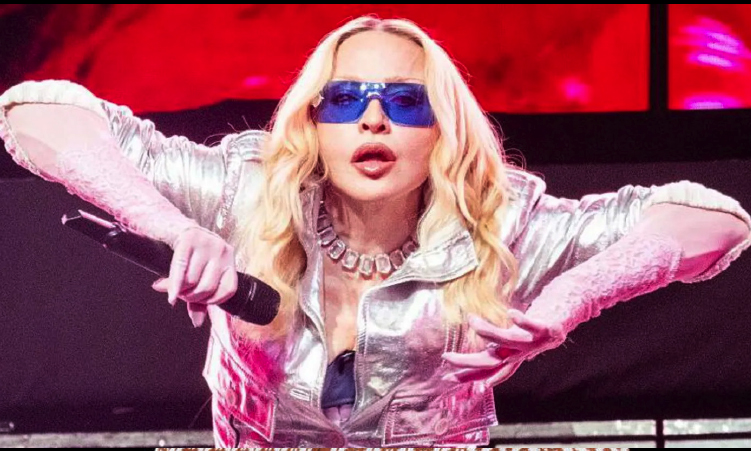
Premiered live at the Coachella festival, it’s the latest in a long line of songs where Madonna bristles at other people’s judgement.
Carpenter’s presence is well earned. Like Madonna, she’s weathered a storm of sexist commentary about her lyrics and outfits, often by people who’ve mistaken her satire of male sexual desires for an endorsement.
On ‘Bring Your Love’, they join forces in a declaration of strength: “I know where the bodies are buried / Don’t try to shut me up.”
RAGE AGAINST THE ALGORITHM
Intriguingly, the song also finds Madonna rejecting the idea of commercial success.
“I say, ‘Don’t try to distract me with numbers’, because I started [this album] without thinking about the charts and streaming,” she recently told Vogue Italy.
“Working only in terms of algorithms and artificial intelligence doesn’t allow you to take risks, which is the complete opposite of making art.”
Madonna’s output in the 2010s sometimes suffered from unconvincing attempts at pop relevance. Here, she doesn’t even bother to reference current dance trends.
Instead, ‘Confessions II’ casts its eye back to the Chicago and Detroit house movements of the 1980s – overlapping hotbeds of musical innovation, spiritual optimism and lesbian, gay, bisexual, transgender, queer and others expression, which Madonna knows intimately.
She even samples pivotal tracks from the era, including Inner City’s ‘Good Life’ and Lil Louis’ ‘French Kiss’.
The closest relative in her back catalogue is 1993’s Erotica, which was similarly inspired by underground house music while tackling themes of upheaval and loss in the midst of the HIV-AIDS crisis.
Loss is prevalent here too.
Madonna grieves for her late brother Christopher on ‘Fragile’, a delicate song about their childhood, estrangement and reconciliation that ends with her wishing, “I hope you found a higher ground”.
More successful is ‘Betrayal’, a jazzy, trip-hop excursion that appears to be about Madonna’s stepmother, Joan Ciccone, who died of cancer in 2024.
It’s sequenced with another cross-generational saga, ‘The Test’, where Madonna and her eldest daughter, Lourdes Leon, thrash out their differences over a spacious, trancey instrumental.
“You didn’t ask for all the flashing lights […] I wish I knew the pain I caused,” sings Madonna in a rare mea culpa.
Lourdes responds with a verse acknowledging her mother’s love, while asserting her independence. “I trace the line of what you have sewn [but] keep my own design.”
The album concludes with another memory song, ‘L.E.S’, which finds Madonna daydreaming about an early crush on a guitar-playing boy from New York’s Lower East Side.
It’s funny. Madonna started the record craving anonymity, but by the end she’s lifted that purple veil. This is the closest we’ve come to hearing the real Madonna since ‘Ray of Light’, almost 30 years ago.
As a great lyricist once observed: Only when she’s dancing can she feel this free.
STANDOUT TRACKS
‘Danceteria’: A thrilling evocation of 1980s New York, where hip-hop groups and fashion designers would hang out with Lou Reed and David Byrne. “Everyone here is a work of art,” sings Madonna as she travels back in time.
‘Love Sensation’: A big, bouncy summer anthem, with flashes of Daft Punk and Stardust.
‘Bring Your Love’ (featuring Sabrina Carpenter): Two titans of pop defend their right to explore female sexuality in all its forms, over a chunky piano house groove that nods to ‘Express Yourself’.
‘Bizarre’: A much-rumoured Kylie duet doesn’t appear on ‘Confessions II’, but this bright, loved-up track would have been the perfect vehicle.
– BBC