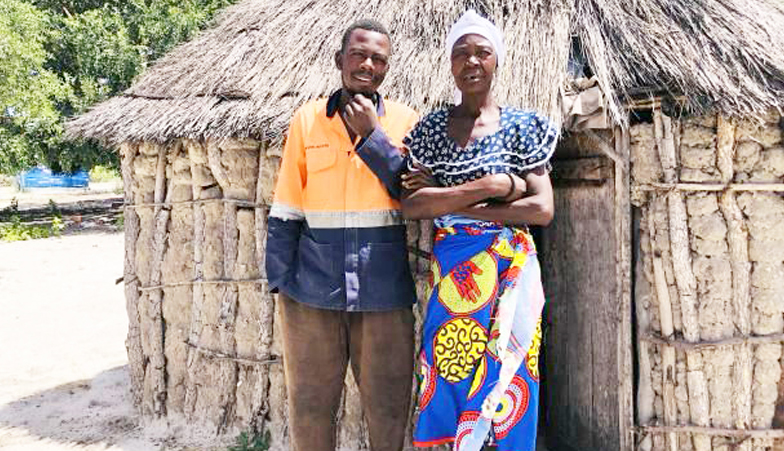
For nearly three decades, Maria Kambinda (77) has lived at Ncamagoro village in the Kavango West region without identification.
A resident of the area since arriving from Angola with her late brother in 1997, Kambinda remains undocumented.
This lack of identification has created a generational cycle of exclusion, leaving her four children and 16 grandchildren undocumented and in a state of legal limbo.
Without national documents, the family’s life is defined by uncertainty. They have no access to secure employment, limited access to education beyond primary level, and no reliable social safety net.
Kambinda has spent years navigating the bureaucracy of the Ministry of Home Affairs, Immigration, Safety and Security, recounting numerous visits during which officials recorded her details and issued receipts, only to instruct her to wait.
Despite a more recent outreach registration, the expected progress did not materialise.
To survive, Kambinda relies on seasonal farm labour and her work as a traditional healer.
During the rainy season, she hires herself out to nearby fields for about N$40 per day. When cash is unavailable, she exchanges labour for food.
“We exchange what we have. If someone has a bowl of food, we trade by working for them in exchange for food,” Kambinda says.
The consequences of her undocumented status are evident in her son, Anton Lazarus (25).
Although he attended school up to Grade 10, largely due to leniency from teachers on his lack of documentation, his progress stalled in 2022. When he attempted to enrol with the Namibian College of Open Learning, he was turned away for not having an identity document.
Lazarus briefly found work as a housekeeper at a lodge, but the job lasted only three months.
“I worked for three months and my then boss started asking me for documents. I told him I don’t have any,” Lazarus says.
“That’s when he suggested I go back home, because he said if the government finds me working without documents, they would arrest him, and that’s how I found myself back home again.”
Lazarus says he hopes to study, secure housing materials and start a small poultry business in the future.
“We are crying for documents. If there’s a way, I am willing to start a poultry business, but I cannot apply because of the documents,” he says.
Ncamagoro constituency councillor Thomas Rengi acknowledges the family’s plight but points to structural barriers. He says Kambinda lacks parental records or birth certificates from either Angola or Namibia, making it difficult to meet the criteria for citizenship.
For her children, the absence of hospital records, as many births occurred at home or records were lost, complicates efforts to prove Namibian birth.
“It is very sad when I look at the situation of the old woman. She has come to my office several times, and now has stopped because there is no assistance,” Rengi says.
He says while the office provides occasional food parcels through disaster risk programmes, a permanent solution depends on the enactment of the stateless bill, which has yet to become law.
Home affairs ministry spokesperson Margaret Kalo has confirmed that the ministry is aware of those who missed previous registration windows. She says two legislative measures are under development, namely the regularisation of status of certain residents of Namibia bill and the stateless determination and protection bill.
Kalo says the proposed laws are intended to provide legal pathways for those holding old South West African identification and those without nationality.
While acknowledging the humanitarian concerns raised by Kambinda’s case, the ministry says compliance with existing legal requirements remains necessary until the laws are enacted.
In the meantime, the Kambinda family continues to rely on occasional work and safeguards the paper receipts issued to them over the years, as they await a resolution to their status.
– Nampa