



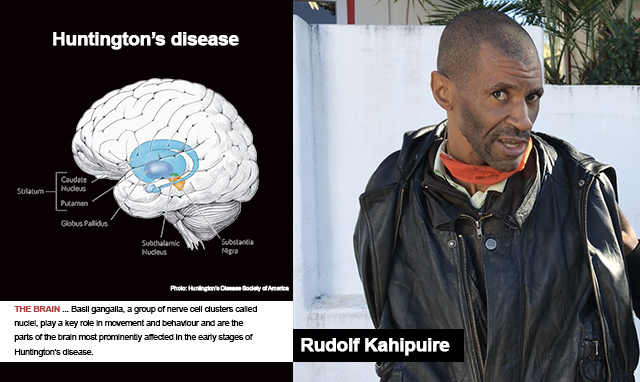
RUDOLF Kahipuire is living with a brain condition that affects his ability to live a normal life.
Kahipuire (38) was diagnosed with Huntington’s disease (HD) six years ago at the age of 32. The disease affects his speech and sometimes his movements.
He left school in Grade 10 and used to be a long-distance taxi driver, but says he lost the possibility of living a normal life after developing these symptoms.
The disease, which is genetic, is characterised by uncontrolled movements, emotional issues and a loss of cognitive ability.
Huntington’s disease is not curable and progresses with age.
Kahipuire was diagnosed when he realised he was struggling to walk.
“Suffering,” he blurts out.
After losing his job as a taxi driver, he now has to survive on his monthly government disability grant of N$1 300.
Although an uncomfortable journey for him, Kahipuire travelled from Okakarara, hoping to get an interview with The Namibian to tell his story.
Since he was struggling to communicate during the interview, his sister Charmaine Kahipuire assisted.
Before he finishes a word or a sentence his body jerks and twitches.
He also tends to be stiff in some areas and struggles to keep his balance.
“In 2013 he started to show some signs. He was working in Canada, but had to come back because of his condition,” Charmaine says.
Kahipuire is able to bath and feed himself to an extent, but requires supervision.
“He has spilt coffee on himself before,” Charmaine says.
She says Rudolf remains hopeful that he may be able to receive treatment to alleviate his symptoms, even though the disease is not curable.
Kahipuire is currently on prescribed medication, which he collects every three months in Windhoek, but is not receiving physiotherapy.
Speaking at the 35th Huntington’s Disease Society of America (HDSA) virtual convention earlier this month, neurologist Dr Victor Sung, who is based in the United States, said there is a difference between being gene positive and having Huntington’s disease.
“Presymptomatic is when you’ve had the gene test and you’re gene positive, before symptoms start,” he said.
Sung said being a Huntington’s disease gene extension carrier (HDGEC) means you carry the expanded genetic mutation for the disease.
Huntington’s disease, on the other hand, is defined by the presence of the symptoms of the disease.
“Just because you’ve tested positive doesn’t mean you have the disease yet, it just means that over time you may develop it,” he said.
The HDSA says people who are at risk of the disease face a difficult choice when it comes to genetic testing for HD because of the current absence of an effective treatment or cure.
“Many people see no benefit in knowing they will someday develop the disease. Others want an end to uncertainty so that they can make informed choices about the future. The decision whether to test or not is intensely personal,” the organisation says.
Watch Rudolf Kahipuire’s story on The Namibian’s YouTube channel.
In an age of information overload, Sunrise is The Namibian’s morning briefing, delivered at 6h00 from Monday to Friday. It offers a curated rundown of the most important stories from the past 24 hours – occasionally with a light, witty touch. It’s an essential way to stay informed. Subscribe and join our newsletter community.

The Namibian uses AI tools to assist with improved quality, accuracy and efficiency, while maintaining editorial oversight and journalistic integrity.
Stay informed with The Namibian – your source for credible journalism. Get in-depth reporting and opinions for
only N$85 a month. Invest in journalism, invest in democracy –
Subscribe Now!