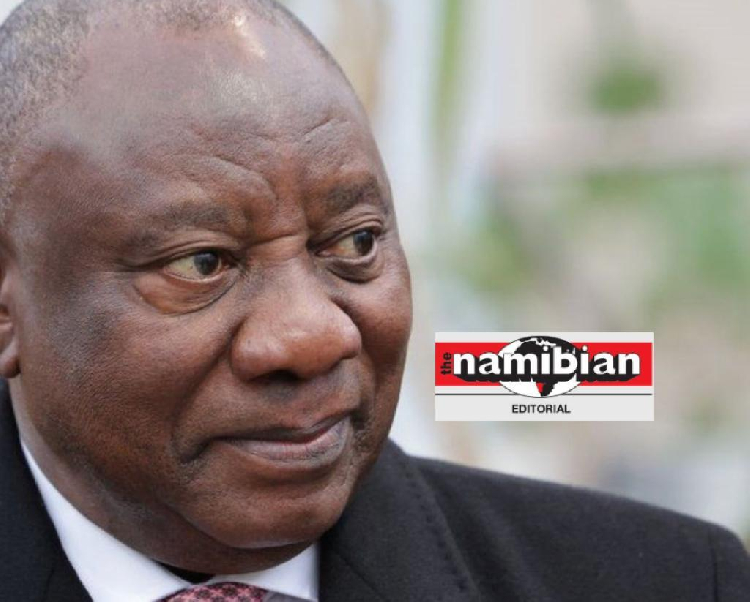
CYRIL RAMAPHOSA is surely a dead man walking. It’s not catastrophic for a man to fall on his proverbial sword though.
If anything, Namibian leaders entangled in the case could and should learn from Ramaphosa about strengthening state institutions for the betterment of society even if it militates against their personal survival.
The South African president is facing certain political demise stemming from an incident in which private money of his was stolen from his Phala Phala game farm. Strange but true – it’s the opposite of common scandals when politicians steal public funds.
An independent parliamentary panel has determined that Ramaphosa should formally answer serious constitutional violations for exposing himself to a conflict of interest, doing paid work outside of government and abusing his powers by asking Namibian authorities to conceal the crime on his farm.
Whether the matter will reach impeachment remains in the realm of speculation for now, since the ANC dominates parliament.
What is clear is that Ramaphosa and the ANC are in deep hot water.
Yet, for the broader South African body politic, Ramaphosa’s fall from grace is a sign of the strength of that country’s good governance infrastructure aimed at curbing the abuse of state power.
Ramaphosa’s sins do not seem to match the horrifying corruption and state capture of his predecessor Jacob Zuma. His sins include calling president Hage Geingob to help him apprehend Namibian suspects who stole his money using South African resources.
There’s also no indication, at least so far, that the money stolen was the proceeds of corruption involving the public purse.
It is the very conduct of the president, the betrayal of public trust that spells doom for Ramaphosa’s relatively clean political image. After all, he got into office promising to clean up corruption and state capture.
The panel’s recommendations are bound to derail what seemed an easy passage into the second term of his presidency at the ANC’s conference meant to take place this month.
While ANC lawmakers have defended Ramaphosa as having done no wrong, South Africa’s governance could not prevent institutions from allowing investigations into and adverse findings on a sitting president. Alas, in Namibia, parliament will not even entertain posing questions to the head of state.
The ruling party Swapo held a congress this past week at which they wouldn’t put measures in place to suspend and investigate leaders who face serious allegations of corruption.
Instead, president Hage Geingob was more concerned about his comrades who are facing long trials.
Geingob said nothing about strengthening ethical codes and anti-corruption institutions – such as access to information and whistleblower protection.
The president is correct to bemoan the fact that corruption court cases take too long. But in most cases, it is because Namibia’s law enforcement agencies and the judiciary are poorly resourced.
Geingob and fellow political leaders should learn from Ramaphosa by taking action aimed at strengthening the good “governance infrastructure” that he so often pays lip service to.
Some among the ruling elite are now quietly complaining that they fear retired generals could have a huge influence in the next government.
The Swapo congress was a missed opportunity to put in place pro-democracy and anti-corruption watchdog policies to curb potential abuse of power by unelected forces.
Further, by taking a few steps such as opening up access to information, the government would involve the general public in fighting corruption and strengthening democracy.
Instead of complaining that several of his comrades were corrupt and should have been in jail, Geingob should improve Namibia’s governance infrastructure.
Take a leaf out of Ramaphosa’s book even if it means falling on your sword by having institutions that function in the best interest of the broader populace.