




Lentils (Lens culinaris) are one of the first domesticated crops in the Near East and have been part of the human diet for between 9 000 and 13 000 years. Crop lentils are relatively drought resistant and the world’s largest producers of lentils are Canada, India and Australia.
It is part of the legume family and derives its name from its lens-shaped seeds. It is a staple food in South Asian countries such as India, Pakistan, Bangladesh and Nepal and is perhaps best known by its Indian name dal (also: daal, dahl or dhal). Lentils that are whole (as oppose to being split) are referred to as gram.
It is common to dehusk and split the lentils to increase digestibility and palatability. Cooking time for lentils could be anything between 10 and 40 minutes, depending on the type of lentil and whether it has been dehusked or not. Lentils are soaked in water prior to cooking to reduce cooking time and are cooked in unsalted water to prevent them staying hard even when cooked. Acid has a similar effect and is thus also added after the lentils have been cooked.
In South Asia, it is commonly eaten as a ‘stew’ with rice or flatbreads such as rotis and chapattis and in other parts of the world, lentil soup is popular, as are lentils as a salad.
Lentils have about three-and-a-half times the amount of protein than rice and two-and-a-half-times that of wheat, making it an excellent source of protein for those with a meatless diet. Dry dal contains about 25% protein by weight but when cooked, the protein contents shrink to only 9% (plus 70% water, 20% carbohydrates, 8% fibre and 1% fat).
By itself, lentils have no amino acids, but when consumed with wheat (such as the rotis and chapattis) and other nuts and seeds, vital amino acids are introduced making the lentil a complete protein (i.e. a protein with an adequate proportion of all nine of the essential amino acids necessary for the dietary needs of humans or other animals).
Most preparations of lentils start with the soaking of the dried lentils. To make dal, the soaked lentils are cooked with spices such as turmeric and perhaps onion (but no salt and no acid). Depending on the dish, the lentils may be mashed before being seasoned. Most dal dishes are finished with a spice mix tempered in hot oil or ghee (clarified butter). This garnish goes by many names such as chaunk, tadka and tarka and includes spices such as mustard seeds, dried chilli, fenugreek seeds, nigella seeds, fennel seeds, cumin seeds and asafoetida.
Dal may be one of my favourite winter dishes. It is comforting, easy to make, affordable and quite delicious.
I have recently discovered a small spice shop that stocks all the authentic Indian spices. It is the proverbial culinary goldmine right on my doorstep.
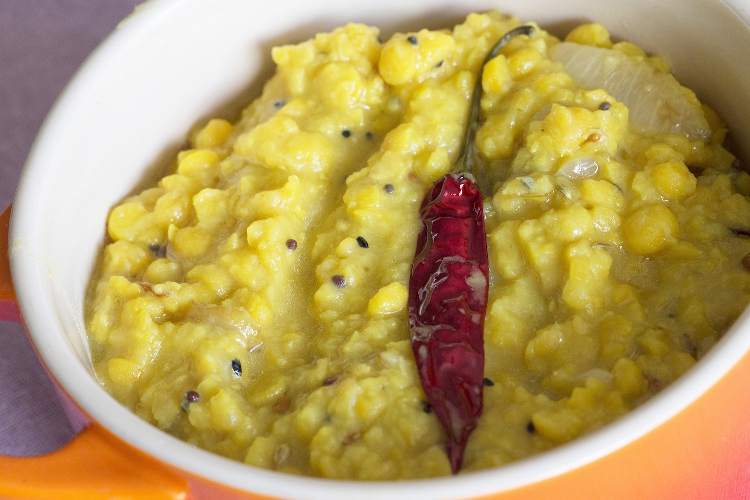
This week’s recipe uses yellow lentils called chana dal and a tarka called panchphoran.
As they say in Hindi: “kripya bhojan kä ännand lijïyai” – please enjoy your meal.
Yellow Lentils (Chana Dal) With 5 Spices
Ingredients
• 180 grams yellow lentils (chana dal)
• 1/4 teaspoon ground tumeric
• Medium white onion, cut in half lengthwise then sliced thinly
• 1 teaspoon salt
• 2 tablespoons ghee (or vegetable oil)
• 1 to 2 dried red chillies
• 1 teaspoon panchphoran (five-spice mixture)
Panchphoran (Five-Spice Mixture)
• 1 tablespoon fennel seeds
• 1 tablespoon mustard seeds
• 1 tablespoon fenugreek seeds
• 1 tablespoon cumin seeds
• 1 tablespoon nigella seeds (aka kalonji)
• Put the lentils with the turmeric and half the sliced onions in
a pan filled with one litre of water. Bring to a boil over
medium-high heat but take care not to let the pan boil over.