





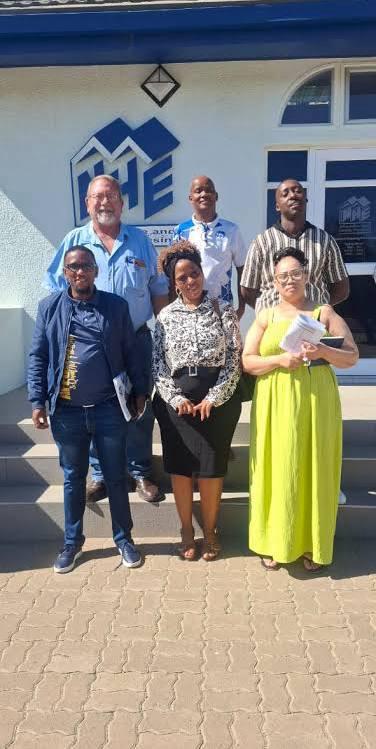
The Koës Village Council and the National Housing Enterprise have signed an agreement at Keetmanshoop in the ||Kharas region for the village to participate in the National Informal Settlement Upgrading Programme.
The village aims to build about 300 houses.
The programme is a government initiative spearheaded by the National Housing Enterprise (NHE) in partnership with local authorities and ministries such as the Ministry of Urban and Rural Development.
Its core slogan is ‘From Plot to Home’.
NHE southern branch manager Ambrosius Khachab has confirmed that the assessment of clients’ affordability has already commenced, with the construction of houses expected to start before the end of the year.
“The NHE has identified several extensions for the National Informal Settlement Upgrading Programme. Koës village is one of the settlements that have shown administrative readiness, with a waiting list and clients with affordability,” he says.
As about 70% of the local population cannot meet the strict credit requirements of standard commercial banking institutions, low-to-middle income earners in small economies like Koës find standard building materials and modern construction options financially out of reach.
|Khachab says the agreement pairs the NHE’s building equipment, institutional funding, and alternative designs with the village’s land availability, while the housing designs offer a basic structural shell without expensive final finishes.
He says this brings down input costs and targets low-income individuals who do not qualify for traditional mortgages.
“The objective of the programme is to help eligible citizens who already own a serviced plot or land at an informal settlement across the country to transition from a plot to a permanent, quality, and affordable house.
“Secondly, the beneficiaries pay mainly the capital cost of the house, as the central government and NHE have waived interest,” the southern branch manager says.
Identified villages and towns include Nkurenkuru, extensions 4 and 11, Okahao, Okashenda Proper, and the Ongulumbashe and Saamstaan extensions at Usakos.
Others incude Katima Mulilo in Choto Proper, for Choto extensions 1 and 2 and Butterfly, Tsaraxa-Aibes at Otjiwaronngo, DRC, Ombili and Orwetoveni extensions 8 and 11, Oshikuku extensions 5 and 9, Opuwo Ext 7, Aimablaagte extensions 2 and 3 at Mariental, Donkerhoek, as well as Henties Bay.
Koës village faces severe land-servicing restrictions due to an outdated and failing utility infrastructure. The village is geographically situated on top of a shallow water table (with water sitting just 6m underground in some areas), raising serious environmental and engineering complications for building foundations and sewage disposal.
Therefore, acting chief executive Johan Brandt has welcomed the partnership. He says the demand for low-cost housing at Koës is high, but that the partnership would also ease the geographical challenges being faced.
“The partnership is timely, and the more flexible credit and affordability assessments offered by the NHE compared to commercial banks make the burden lighter for residents,” he says.
Brandt urges beneciaries who have been allocated land or plots to visit their nearest NHE branch or local authority for housing provision.