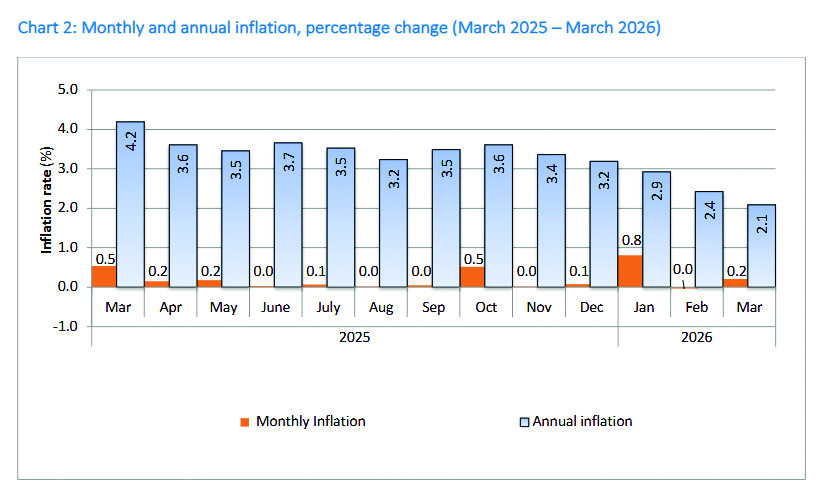
The Khomas region in zone 2 registered the highest annual inflation rate of 3.2% for March, surpassing the national rate of 2.1% for the month.
This was followed by zone 3 comprising the ||Kharas, Erongo, Hardap, and Omaheke regions at 2.0%, and zone 1 comprising the Kavango East, Kavango West, Kunene, Ohangwena, Omusati, Oshana, Oshikoto, Otjozondjupa, and Zambezi regions, which recorded the lowest annual inflation rate at 1%.
According to the Namibia Consumer Price Index (NCPI) for March, issued by the Namibia Statistics Agency (NSA), and an analysis of average retail prices for selected products in March, consumers in zone 3 paid the highest price for 5kg of maize meal at N$69.74, followed by zone 2 at N$69.22, while zone 1 consumers paid the lowest price at N$66.96.
“However, zone 1 consumers paid the highest price for biltong at N$525.87 per kg, followed by zone 2 at N$500.83, while zone 3 consumers paid the lowest price at N$408.32,” NSA statistician general Alex Shimuafeni says in the bulletin.
He says the main contributors to the 2.1% annual inflation rate for March 2026 were housing, water, electricity, gas, and other fuels, which contributed 1.1 percentage points, followed by food and non-alcoholic beverages contributing 0.4 percentage points.
“Alcoholic beverages and tobacco, together with all other groups, each contributed 0.3 percentage points,” he says.
Shimuafeni says the housing, water, electricity, gas, and other fuels component, which accounts for 28.4% of the consumer basket, recorded an annual inflation rate of 4.6% in March 2026, compared to 3.8% in March 2025.
“The increase in annual inflation for this category was mainly driven by price increases in the electricity, gas and other fuels subcomponents, which increased from 1.8% to 4.1%,” the bulletin says.
Food and non-alcoholic beverages, which carry a weight of 16.5% in the NCPI basket, recorded an annual inflation rate of 1.7% in March this year, down from 6.2% registered in the same period of 2025.
“On a monthly basis, this category recorded an increase of 0.4%, compared to 0.5% recorded in the previous month,” the bulletin says.
Food as a subcategory makes up 14.8% of the total consumer basket in the NCPI, whereas bread and cereals account for the largest weight of up to 4.8% of food items bought by households, followed by meat (3.5%), sugar, jam, honey, syrups, chocolate, and confectionery (1.4%), and vegetables, milk, cheese and eggs (1.2% each).
Bread and cereals recorded a deflation of 1.1% in March, compared to inflation of 6.1% in the corresponding month last year.
The decline in the inflation rate for this category was mainly reflected in the prices of maize meal/grain (from 11.4% to -5.6%), rice (from 11.4% to 2.2%), bread (from 5.4% to -0.5%), and mealie rice/malt (from 2.6% to -1.2%).
The agency says the annual inflation rate for fish stood at 1.3% in March 2026, compared to 7.9% registered in the same period of the previous year.
The slow increase was driven by a decline in the price levels of fresh, chilled and frozen fish – from 10.9% to – 3.2%.
The transport category, which carries a weight of 14.3% in the consumer basket, recorded a deflation of 1.7% in March 2026, compared to a 2.6% increase observed in March 2025.
“The decrease was reflected in all the subcomponents of this category, while on a monthly basis, this category recorded an inflation of 0.4% in March 2026, from a deflation of 1.2% recorded in the previous month,” the NSA says.
– email: matthew@namibian.com.na