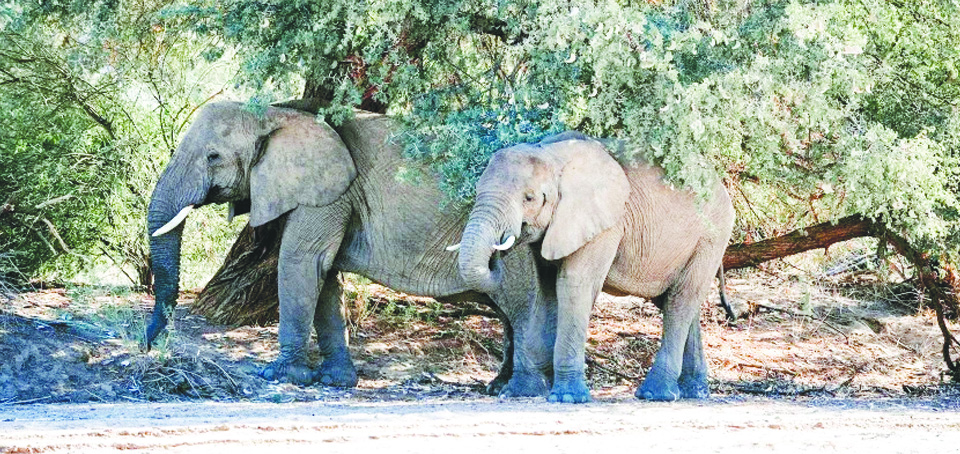
A herd of elephants has allegedly destroyed crops in several villages in the Okahao and Tsandi constituencies of the Omusati region.
Villagers claim that the elephants, which move in groups of two, six, eight, and sometimes as many as 40, have been frequenting their villages since last month, leaving many farmers fearing significant losses this harvesting season.
The animals reportedly invade crop fields at night, feeding on mahangu, maize, melons and other produce, and in some cases damaging property.
Okahao constituency councillor Leonard Shikulo yesterday confirmed that elephants have been sighted in the Okahao, Tsandi and Onesi constituencies.
He said the animals have destroyed a significant amount of crops.
“The elephants are not only in my constituency, they are also in the Tsandi and Onesi constituencies.
Farmers have worked hard on those crops,” he said.
He said the number of elephants appears to be increasing.
“We do not know whether the fire at the Etosha National Park last year might have caused them to leave the park, or where exactly they are coming from,” he said.
He explained that regional councillors have reported the matter to officials from the Ministry of Environment and Tourism, which is responsible for wildlife management.
“The elephants sleep here today and tomorrow they are elsewhere, while at the same time another group is reported in a different village,” he said.
“We report these incidents to the Ministry of Environment and Tourism.
It is up to them to decide what action to take, as it is not within the regional council’s mandate. Our role is simply to report,” he said.
Tsandi constituency councillor Junias Amunkete could not immediately comment, saying he was out in the field at the time.
Meanwhile, a resident, Malakia Jeremia from Oshilulu village in the Okahao constituency, says the elephants have caused widespread damage in his area and nearby villages, including Ombwata B, Iitapa, Olyasiti, Oshandumbala and Onanyanga.
“I don’t think we will harvest anything this year. The elephants have been visiting our villages every week since last month, and they were here again last week,” he says.
Jeremia adds that despite reporting the matter to the ministry, no action has been taken yet.
“Some houses have also been destroyed by the elephants, and our lives are at risk. The elephants move in groups of two, six, eight, and sometimes even 60 or 80,” he says.
Christof Mashuna, who spoke on behalf of the Itapa village headwoman, says the elephants have destroyed more than 10 mahangu fields in the village. He expresses frustration at what he describes as “a lack of response from authorities.”
“They come and look at the damaged fields and then leave. They do not remove the elephants from the area.
They even told us not to grow maize and melons.
We do not sleep at night because elephants have destroyed houses,” he says.
Mashuna says the ministry does not remove the elephants, but anyone who kills one is arrested.
“What are the elephants looking for at the villages? Why can’t they be taken to Etosha?” he asks.
He adds that compensation of about N$2 000 per destroyed mahangu field is not enough to support large families.
Mashuna calls for urgent intervention to protect both livelihoods and lives.
Environment ministry spokesperson Vilho Hangula says the ministry has requested authorisation to cull one elephant in an effort to scare others away.
“Another intervention is to deploy a helicopter to drive them out of the affected areas.
We are busy with its servicing and licensing so that it can be dispatched to assist in moving the elephants away from the community,” he says.
He urges villagers to be patient, assuring them that the ministry will intervene soon.