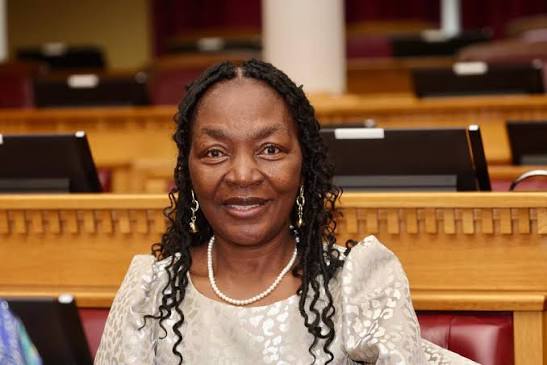





Kephas Harry ‘/Awasab’ Conradie, known to many as ‘King Jury’, was a fearless revolutionary, freedom fighter, community activist, cultural steward and servant of the Namibian people.
His life was a long, unwavering march against injustice, and now – more than a decade after his death – his family is preparing to unveil his tombstone at Katutura Cemetery on 28 June at 06h00.
This event marks the 11th anniversary of his journey to join his Khomani/ Gobani ancestors.
ROOTS AND EARLY LIFE (1937 – 1954)
Conradie was born on 7 November 1937 in Windhoek’s Old Location during one of the darkest eras of colonial oppression in Namibia.
His ancestral roots lie in! Ao-llAexas, now known as Daan Viljoen in the Khomas region.
Growing up under apartheid in South West Africa, the young Conradie was exposed early to the brutal injustice and inequalities that scarred black lives.
Even as a boy, he showed signs of a fearless spirit. He started his school career at the Nama Staatskool and later moved to MH Greef Primary School until Standard 5 (Grade 7).
Thereafter, he proceeded to Dr Lemmer High School to complete his high school education.
At the tender age of 17, he joined the Damara Executive Committee in 1954, commencing a lifelong journey of political struggle.
POLITICAL ACTIVISM AND RESISTANCE (1954 – 1969)
Conradie emerged as a key figure in the 1959 Old Location uprising.
He led protests against the apartheid regime’s plan to forcibly move black Namibians to the Katutura township.
He publicly rejected the use of racist establishments like the beer and dance halls and municipal bus services, refusing to accept anything that symbolised subjugation.
When the protest escalated, 13 residents were gunned down, 43 were wounded and several others imprisoned.
Conradie stood bravely and undeterred among them. That day marked a turning point in Namibia’s liberation story, and he was at the heart of it.
He marched, strategised, and resisted alongside chief Hosea Kutako, Sam Nujoma, Clemens Kapuuo, Frits /Awaeb Gariseb, Jeremia Jagger, Gerson Hitjevi Veii, Johannes Skrywer, Moses Garoeb, John Muundjua, Uatjiua Kaukuata, Alfred Gawanab, Josephat Gawanab and many others.
In a now legendary moment, Conradie resiliently barricaded himself and refused to evacuate his corrugated iron house when the municipality policemen, De Wit and Potgieter, surrounded the Old Location with military trucks for demolitions.
He dared the authorities by chanting: “Let them demolish it with me inside, I’m not afraid.”
It was only after a dramatic confrontation, and desperate pleas from his mother, Maline !Owoses-Conradie, and relatives such as his cousin Herbert Conradie, that he reluctantly emerged.
He did this not out of fear, but out of deep cultural respect.
In 1966, when Gerson Veii was arrested for alleged incitement, Conradie secretly raised funds – ostensibly for a Land Rover – to pay for Israel Goldblatt, the lawyer who defended Veii.
Conradie and Fillemon Gawanab, a prominent businessman, were among the final residents to leave the Old Location in 1968. After this, Conradie left for the Damaraland homelands, leaving his belongings in Katutura (Dolam) – a bold act of defiance.
Over the decades, he evolved into a prominent political leader, cultural champion, and freedom fighter.
POLITICAL LEADERSHIP (1969 – 1980s)
In 1966, Conradie was imprisoned at Lüderitz for three months alongside pastor Isaak Fredericks, Lukas Boois and others for anti-apartheid activities.
Even as the state tried to break him, he remained unyielding.
As president of Voice of the People, he joined a delegation in 1972 led by Jeremia Jagger and chief Diederick Isaak. Their petition to South African prime minister John Vorster in Pretoria to reverse the forced removal of the Bondelswarts community from Warmbad to Gibeon and to further restore ancestral land and water rights was a rare triumph under apartheid.
In January 1976, he represented the Namibia National Front (NNF) at the International Convention on Namibia and Human Rights in Dakar, Senegal, reminding the world that culture, heritage, and political rights are inseparable.
He co-founded the Voice of the People party, representing it at the National Convention from 1970 to 1972, and later at the Okahandja Conference in 1974, which gave birth to the Namibia National Convention. In 1978, he played a central role in founding the Namibia People’s Liberation Front, another attempt to unify fractured nationalist voices.
Conradie also participated in the 1979 Geneva Conference on Namibia, convened under United Nations auspices, and continued political involvement through the Federal Convention of Namibia where he served as member of parliament.
STATESMANSHIP (1989 – 1996)
As Namibia moved toward independence, Conradie helped shape the new republic. He joined the Federal Convention of Namibia in 1989 and served as second vice president, first vice president in 1990, and party president in 1994. He was elected to the First National Assembly from 1993 to 1996 where his voice resonated with conviction and clarity.
He served on several key parliamentary committees and was also active in the Commonwealth Parliament.
TRADITIONAL AUTHORITY AND LEADERSHIP
With over three decades of leadership, Conradie served as secretary general of the Damara King’s Council, Senior Traditional Authority of the Royal House, and member of the national Council of Traditional Leaders.
He also led a consultancy focused on constitutional, political, and civil rights advocacy in Namibia.
PROFESSIONAL CAREER
Conradie was employed for six years as a radio journalist at the South African Broadcasting Corporation.
He was a dynamic and resourceful professional, storyteller and a watchdog who painted vivid pictures through sound, ambience, and emotion.
SPORT LEADERSHIP AND NATION-BUILDING (1959 – 1976)
Conradie’s love for football ran deep. From 1959 to 1970, he served as the chairman of the Cape Cross Pirates Football Club, which later became Dolam Pirates Football Club.
From there, he rose to lead football at national level and became secretary in 1966 and then president in 1971 of the Southwest Africa National Football Association.
Under his leadership, sport became a battlefield for justice, equality, and unity.
Conradie was invited to sit on the executive committee of the South African National Football Association, where he represented Namibian interests.
He believed sport could do what politics could not – unite the nation across race, tribe, and class.
EDUCATION
Conradie pursued part-time tertiary studies at the University of South Africa in Pretoria, focusing on political science, constitutional law, private law and anthropology. He proved that the best leaders do not stop learning, even while leading revolutions.
He served over a decade as the school board chairman of Damara High Primary School, today Goreangab Junior Secondary School.
Conradie established a learning institution at Omaruru, which was known as Kha -/Khaos //Khoa ! Hoasa in the late 80s. Even after stepping back from frontline politics, Conradie continued to mentor the youth, be an advocate for land justice, and support community initiatives.
He died on 8 August 2014 at Swakopmund.
ROARING LEGACY
Conradie was more than a name, he was a movement, a moment in history, and a mission that continues.
He was a politician who served with humility, not ego. He was a sportsman who used football as a weapon of unity. He was a scholar who believed that knowledge was power. He was a father, mentor, and servant of the people.
He lived like a roaring lion, fierce, noble, and unafraid.