





Pain. Everyone has felt it, from deep within their souls as it moves across their hearts until it has finally numbed their skin.
Experiencing anguish is part of life, there is no choice in that, but what we do with our pain is up to us.
Ntozake Shange endured the turmoil of what it meant to be a black woman in America during the civil rights movement, the Brown versus Board of Education court decision and the 1970s, when the voices, lifestyle and need for social change of black Americans influenced pop culture, much to the dismay of the majority of US citizens.
Shange used her journey – from being a young woman, losing her virginity, growing up and experiencing love and heartbreak to struggling with thoughts of suicide and finally developing the ability to heal herself – and wrote ‘For Colored Girls Who Have Considered Suicide / When The Rainbow Is Enuf’.
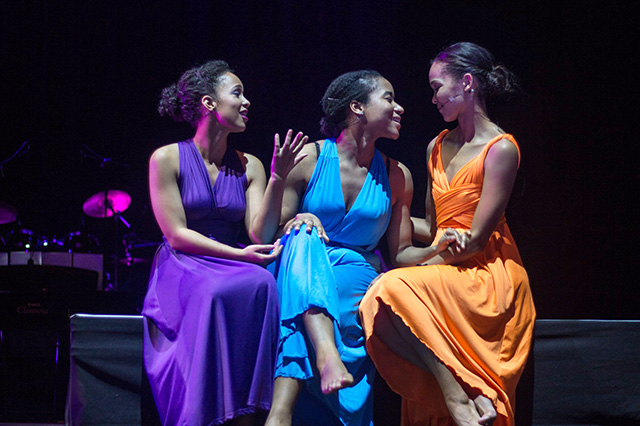
The 20-piece choreopoem revolves around seven women, and was brought to life recently by Christell Nassauw, Xavierie Mbangtang, Diana Master, Odile Gertze, Jeanne-Danae Januarie, Rencha Murere and Counney Kemp, under the direction of Jenny Kandenge, at the National Theatre of Namibia.
The night of the last show was a quiet one. The auditorium was only a quarter full with an enthusiastic and artsy crowd.
Musical director Lize Ehlers and her band, comprised of Chantell ‘Diolini’ /Uiras, Toshi ‘Namib Yaantu’ Haufiku, Vivien Böhmer and Najah Tommasi, sat at the far end of the stage under dimmed lighting.
The ambience was reminiscent of a smokey noir-jazz club in what could have been New Orleans, with sounds of the bass guitar, drums and keyboard setting the mood as the band entered in synchronised fashion and the Lady in Brown (Murere) kicked off the production with ‘Dark Phrases’.
As the poem reaches its end, the women start singing a nursery rhyme accompanied by playful choreography by dancer extraordinaire Nikhita Winkler.
With seamless transitions, the cast worked their their way through the play complete with impeccable lighting; the poems relentlessly diving into the deep end of stories on rape, abandonment, abortion, domestic violence and HIV-Aids, with each performer going for the jugular.
The Lady in Yellow, played by a lively Master, talks about losing her virginity on her graduation in a black Buick, leading the other ladies to reflect on their own sexual tastes. One of the more memorable moments of the night was Gertze’s take on the Lady in Orange. In her interaction with her character, the stage and her fellow actresses and her professionalism in carrying out intricate dance routines with near-perfect form, she has elevated herself into a new realm of performance.
Nassauw took on the Lady in Red, which possibly had the most heartfelt moments and reactions from the audience, especially with ‘A Nite With Beau Willie Brown’ – the same scene Michael Ealy is infamous for in Tyler Perry’s 2010 adaptation.
Although there were stand-out moments during the play, all the actresses executed their parts with utmost professionalism, which must have proved difficult given the vernacular, choreography and emotion entailed in the choreopoem.
Januarie (the Lady in Purple) is fast paving a way for herself as a performer as she mesmerised with ‘Sechita’.
The Lady in Blue (Mbangtang) and Lady in Green (Kemp) also delivered memorable portrayals.
The music set the mood for the play, however, there was little variance and a marked lack of transpositions and melodic changes, which could have added extra oomph in carrying out the message and emotions. As the play is based on African American experiences, the music could have been the bridge to make it relatable to a Namibian audience.
Lighting designer Desmond Coetzee executed a faultless job with timing, ambience and feeling that transitioned with the introduction of each lady accompanied by her coloured light.
Director Kandenge aimed to stay as true as possible to the original work, however, I felt she could have challenged herself further by adapting the language and delivery of the poems to make them more Namibian. Despite this, her direction was spot-on as everything seen and heard on stage fit together like a puzzle.
Given the two-hour length of the play, there should have been an interval. But the simplicity of the stage – only fitted with two parallel stage blocks – allowed the actresses to express themselves and the audience to interact with them. With various things occurring simultaneously, the cast kept the attention on themselves while delivering powerful spoken word pieces.
The play started with pain, but the audience left with healing and food for thought on what it means to be a woman of colour in the modern world.
Kandenge and her creative team paid terrific tribute to Shange with a compelling production.

