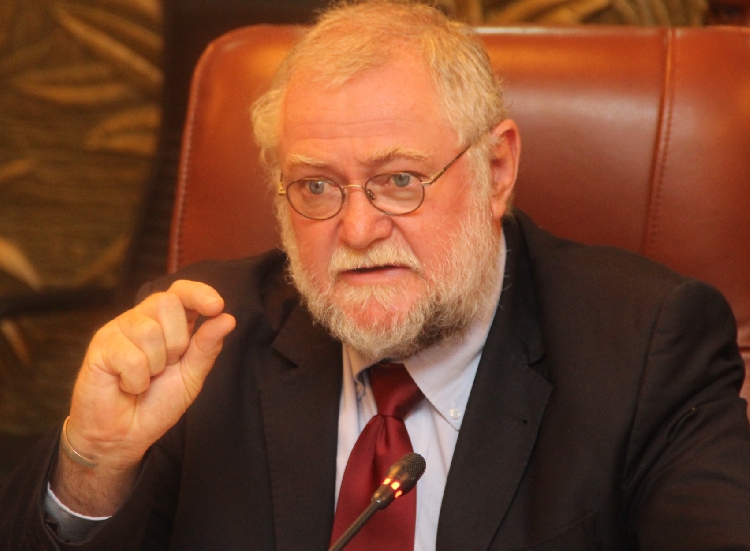




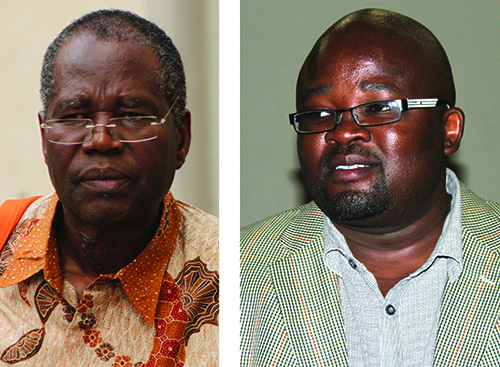
TRADE union leader Evilastus Kaaronda has successfully defended a defamation case in which four top managers of the University of Namibia were suing him for N$1 million.
Three other defendants who were also sued by Unam vice chancellor Lazarus Hangula and three of his colleagues did not emerge unscathed from the case that Hangula and his colleagues lodged with the High Court four years ago, though.
In a judgement delivered in the Windhoek High Court last week, Judge Dave Smuts held the owner of the weekly publication Informanté, Trustco Group International, the former editor of Informanté, Max Hamata, and reporter Patience Nyangove liable for the publication of a defamatory article about Hangula and the top management of Unam in February 2010. Judge Smuts decided that Trustco, Hamata and Nyangove must pay N$120 000 to Hangula and N$40 000 to each of three of his colleagues – Osmund Mwandemele, Job Jansen, and Alois Fledersbacher – and should also pay the four plaintiffs’ legal costs. Kaaronda’s legal costs, though, should be paid by Hangula and his co-plaintiffs, the judge also ordered.
Each of the four plaintiffs was suing Kaaronda for N$250 000 – claiming a total amount of N$1 million from the former secretary general of the National Union of Namibian Workers (NUNW) – while each of them was also claiming N$500 000 from Trustco, Hamata and Nyangove.
Hangula and the other plaintiffs sued Kaaronda over a letter that he sent to former Unam chancellor Sam Nujoma in February 2010. In that letter, written under a letterhead of the NUNW, Kaaronda informed Nujoma about allegations of irregularities and financial maladministration at Unam.
Kaaronda’s letter made its way to Informanté as well. In its edition of 11 to 17 February 2010, an article about Kaaronda’s letter was published in Informanté.
The article was announced with a front-page headline that read “UNAM VC squanders N$5 million – Kaaronda”, while the article itself appeared on an inside page under the headline “UNAM Vice-Chancellor accused of corruption.”
In the article, it was stated that Hangula “and his senior management allegedly embezzled N$5 million meant for the Masters Programme in Public Administration” and that they were allegedly employing expatriates at Unam at the expense of qualified Namibians. It was further reported that Kaaronda had claimed in his letter that the university management had “failed to account” for about N$5 million that was spent in the public administration master’s degree programme.
When he testified before Judge Smuts in May last year, Kaaronda was at pains to point out that he did not state in his letter that Hangula had “squandered” N$5 million, and that he also did not use the word “embezzle” in the letter, Judge Smuts noted.
Kaaronda also said his letter was intended only for Nujoma. He denied that he provided a copy to Informanté as well.
Hangula told the court that expenditure for which supporting documentation could not be found – on which a part of Kaaronda’s letter was based – dated from the time before he became vice chancellor of Unam.
Judge Smuts found that the claims Kaaronda made in his letter were defamatory of the plaintiffs. However, he agreed with an argument by Kaaronda’s lawyer, Steven Nkiwane, that as a leader of a trade union federation that also represented Unam employees Kaaronda had a right to bring allegations about financial maladministration at Unam to the attention of Nujoma in his capacity as chancellor of the university.
Although Kaaronda had created a clearly misleading impression in his letter, he believed that the contents of the letter were correct and it had not been shown that Kaaronda had acted out of malice, the judge found. He further found that Kaaronda’s communication with Nujoma was privileged, which is a defence to a defamation claim.
The media defendants, however, went further than the text of Kaaronda’s letter, Judge Smuts said.
“They embellished upon it in some respects,” he said. The claims that Hangula had squandered N$5 million and that Unam’s senior management had allegedly embezzled that amount did not arise from the letter and were clearly and highly defamatory, the judge found.
He also found that the evidence did not show that theft or embezzlement had taken place. The article that was published suffered from “serious inaccuracy and untruthful and unjustified embellishments”, and amounted to “the reporting of rumours or suspicions which have later proven to be false”, Judge Smuts commented.
While journalists should not be held to a standard of perfection and a court should take into account the pressured circumstances in which journalists work, a court would at the same time not be prepared to condone manifest breaches of good journalistic practice and reporters and editors engaging in slipshod journalism at the expense of quality and accuracy in their reporting, he said.
George Coleman, instructed by Elize Angula, represented the plaintiffs. Phillip Barnard and senior counsel Raymond Heathcote represented Trustco, Hamata and Nyangove.