





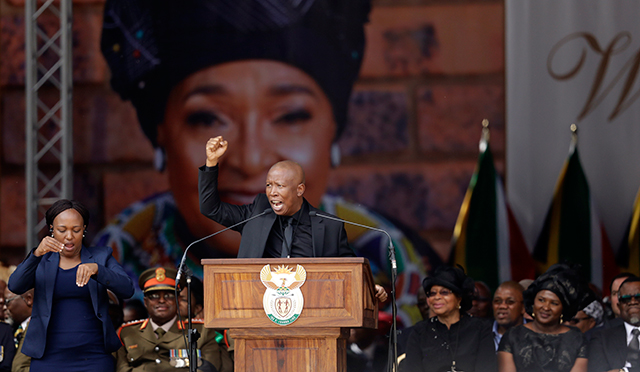
• Richard PoplakNomzamo Winifred Madikizela-Mandela left this broken world this month, and in her absence South Africa nearly tore itself apart.
At issue, as is so often the case during these social media-driven end-times, was a binary debate concerning the particulars of a life: Madikizela-Mandela was either a feminist icon beyond reproach, or a murderer of small children. That the truth was something far more nuanced, far more interesting, appeared to be of concern only to a very few.
Winnie was being claimed – or reclaimed, or discarded, depending on whom one asked – and the process felt like heart surgery without the benefit of an anaesthetic.
This is all to say that Winnie Madikizela-Mandela became a political commodity the second she passed away, a means of legitimising certain points of view, but also of enhancing reputations, personalities and – most gruesomely – parties.
The countless op-eds, memorials, services, and speeches that poured forth following her death, many of them genuinely moving, have nonetheless proven something inviolable about South African life. As the novelist Milan Kundera once put it:
The point here is not to offer another interrogation of Winnie’s vastly important, entirely representative South African life, but to make sense of how political interpretations of her legacy are playing out across our national imaginarium.
She passed away during a vital inflection point in history: In the middle of a land debate that will define the course of the next generation; in the middle of the forensic accounting of Jacob Zuma’s pitiful State Capture mess; in the middle of the first blush of the coalition era; in the middle of a re-upped bout of racial discord; in the middle of the realisation that our entire system – a sort of all-dressed social democracy-lite – is neither healthy nor sustainable in the long run.
The country is not the same place it was before she passed away, and the laboratories where the photographs are retouched are more crowded than they have ever been. But the last bitter laugh belongs to Winnie – because whoever ends up owning her memory, will end up owning the country.
Immediately following Madikizela-Mandela’s death, the governing party powered up the nuclear reactors, and however hypocritically, her mourning was an ANC-branded affair. When sufficiently motivated, the Congress can do this stuff in its sleep – there isn’t another political party in the world that can pull off two stadium events in one week with such slick competence.
But some things were difficult to paper over. As a cultural marker, Winnie’s passing represented an uncomfortable potential turning point: Was it not time to reify the notion that Nelson Mandela’s reconciliation process was a failure, and that sidelining Winnie’s radicalism was an existential mistake that has mired the country in stasis? This makes many within the ANC feel deeply uncomfortable, largely because the party’s high priests never were, and nor are they now, in line with her sensibilities.
Winnie left behind a coalition of centrists, technocrats, gangsters, warlords, fake radicals and genuine reactionaries, whom as a collective constitute an ideological joke, and whose record can only generously be considered mixed.
And so we arrive at a tragedy: In death, Winnie finally ascended to the highest echelons of power, and yet there was not much she could do with it.
In celebrating her record, and in offering endless mea culpas for her mistreatment, the ANC attempted to open a conduit to her unofficial constituency: A generation of young people forged by the Fallist movements, by decades of unemployment, and by endless economic marginalisation – to say nothing of several generations of women beaten back by the same institutional misogyny she faced at every turn. Attempting to retroactively nip and tuck her history so that it was as vague as that of her male counterparts, the ANC welcomed her – and by extension her legions of supporters – home.
The last several weeks have also underscored the provisional nature of Cyril Ramaphosa’s presidency, and the immensely detailed choreography required from him if he hopes to mince his way through his party’s warring impulses.
He must assuage the constitutionalists – the men and women who believe that progress can only happen under the aegis of the document they helped draft… and those who genuinely feel that the constitution holds back black South Africans; that it is yoking them to economic and social mechanisms of the apartheid era, and that it is an impediment to creating a South African utopia.
The ANC in its current state cannot bear these contradictions; it cannot govern because it does not know itself. In their rage, Madikizela-Mandela’s daughters appeared to act as proxies for millions of South Africans railing against the party, the government, the media, the courts, the very transition process itself – the core institutions of public life that they feel have left them behind.
So Ramaphosa must remake his party if he hopes to make a country.
And his salvation wears a pair or red overalls.
The current rhetoric insists that Winnie’s death has brought Ramaphosa and Julius Malema closer to some form of tentative reunion.
That may be true in Ramaphosa’s case, but Malema had this play in mind long before the moment it became apparent that the billionaire would win the ANC national electoral conference. With the endlessly giving Zuma piñata no longer there to pummel, the opposition would obviously lose its focus.
So what to do?
Go radical, baby! Malema and his crew ramped up the histrionics, which earned the EFF president a dozen op-eds accusing him of being a fascist, while he shotgun tweeted racism accusations at the mainstream press regarding the hiring of specific reporters, and railed against writer and editor Ferial Haffajee for the sin of becoming a successful black media professional.
Ferial Haffajee (who had recently referred to Malema as ‘kiddie’ Amin in an op-ed piece) was taking Malema to task for race baiting, and her point was clear – there is a big difference between forcefully calling out racial power imbalances and stoking the embers of race-hatred to score cheap points. Malema was at the time doing both.
It led to the most unconscionable misstep his party has made in its short history. Welcome to Nelson Mandela Bay municipality, where, in a bout of near complete political incoherence, the EFF decided to ‘punish’ the Democratic Alliance for not supporting their land expropriation motion in Parliament.
Malema and his party teamed up with the ANC to put their muscle behind successive no confidence motions against executive mayor Athol Trollip, whose tenuous coalition they had previously backed.
Out of the three DA coalition mayors, Trollip was singled out by the EFF because he is white. But Trollip was born white, he will likely die white, and he was certainly white when he squeaked his way into office. And while the man is no one’s idea of teddy bear, he became mayor because Nelson Mandela Bay under the ANC was a complete sh*t-show, governed by a criminal syndicate who had one thing on their mind: Stealing the place into eternal penury.

