





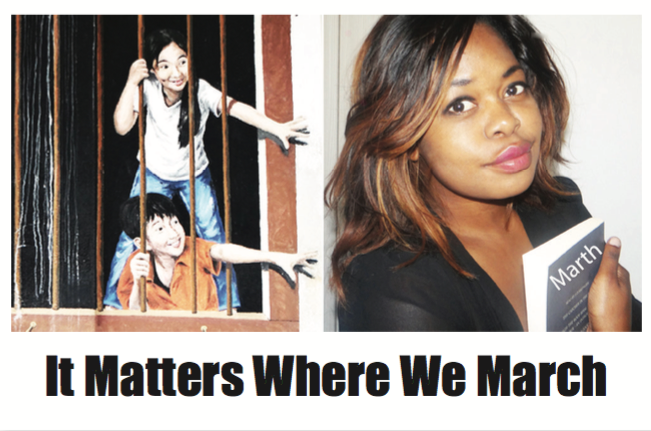
I think the problem with our protest is that we don’t look much like school-goers. Most of us have the air of day jobs, the fine lines of one too many nights out and the distinct aura of having wrestled with adulthood and lost.
I suppose that’s why the woman in a white Range Rover is staring, nay, scoffing.
It’s around 10h00 on a Saturday morning and a handful of us – television, film and theatremakers, journalists, an author – have taken to Robert Mugabe Avenue to yell from our protest signs.
“Educate a mother, educate a household!”
“She is tomorrow’s leader!”
“Sex with a 16-year-old is rape!”
“Girls matter!”
It’s great work organised by great people but the police escort is overkill unless they’re safeguarding us against eye rolls.
Nobody showed up.
Worse, the protest is so utterly devoid of the people it primarily concerns that we look a ragtag bunch of the relatively elite a little at a loss on a Saturday morning.
To be clear, this is vital work by excellent people but I think it matters where we march.
We’re advocating for the girl child as part of this year’s 16 Days of Activism, particularly the girl child who misses class because her family cannot afford sanitary products and the teenage mother who wants to stay in school, but we’re protesting on one of the most affluent avenues in Windhoek.
Unesco says that one in 10 sub-Saharan African girls skips up to five days of school each month because she does not have access to sanitary products.
They come from low income households, their parents are already struggling to make ends meet, so sanitary products are relegated to the non-essential, forcing many to manage their periods from home with scraps of material or old T-shirts rather than risk bleeding through their makeshift pads and facing ridicule at school.
Though it’s true that people completely unaffected by an issue can use their privilege and position to raise awareness of those whose voices are routinely ignored, there is also something to be said for involving the community.
For stepping out of our comfort zones, going to where the problems are most pressing and using police escorts in areas where they may actually be necessary.
The author and I imagine the very same protest in Katutura, Khomasdal or in the North.
We imagine engaging schools, educating pupils and inviting them to join us in their own community while assisting them to be the heroes in their own stories.
Like the white saviour, the elite saviour can be problematic.
They can centre the struggle on scenic streets far removed from the issue’s epicentre while assessing problems from outside the reality and without the nuance and understanding of lived experience.
It matters where we march.
When we stage political plays, activist theatre and lament the plight of the poor through song, dance, protest or whatever means we choose, it should occur to us that visibility is two-fold.
It should engage the people with the power to sign change into policy and law and it should also inspire those affected to demand dignity and reform while underscoring the idea that they can hold those who seek to oppress, overlook or dehumanise them accountable.
Walking down Robert Mugabe Avenue wondering why nobody showed up or ran from their cars to join us, I realise it’s because it’s not their problem.
Zipping by in their fancy cars, off to breakfast or to shop on a bright Saturday morning, it is not the people seeing us’ problem.
So perhaps we should create a ground swell with the people affected?
Though a walk from Parliament Gardens to Government Park to deliver a petition demanding government provide free, safe and reusable sanitary towels to all teenage girls in government schools and review the 2008 Education Policy on the Management and Prevention of Learner Pregnancy is a noble endeavour, like many protests or performances staged in the city centre by the activist elite, it omits to involve or engage the affected stakeholders.
So let’s march where it matters.
Let’s ignite the spirit of participation and help communities help themselves.

