







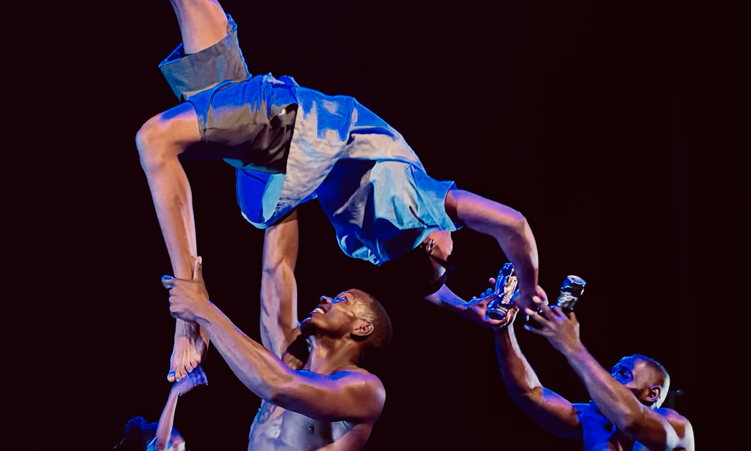
There’s a special kind of delight inherent in watching people defy stereotypes. In the first season of ‘Movement’, dancers with disabilities took to the National Theatre of Namibia’s Backstage for a night of integrated dance and social awareness.
‘Movement’ is an international dance festival supported by the embassy of France in Namibia and began with a production titled ‘Belong’. The showcase was a dance performance in three acts featuring South Africa’s Unmute Dance Theatre.
Telling stories of rejection and acceptance performed by the Ombetja Yehinga Organisation (OYO) dance troupe and guest dancers with disabilities, the first two acts of ‘Belong’ spoke to the social challenges and stigma experienced by deaf and blind people.
While ‘Bin Boy’ was performed by the OYO dance troupe, the second act included the premiere of ‘Hear Me’, featuring dancers with different abilities. ‘Hear Me’ was supported by the Embassy of Finland in Windhoek. The dance project was advertised through the National Federation for People with Disabilities, and the performers went through a formal audition process.
“‘Hear Me’ is an inclusive piece featuring some OYO dancers such as Desmond Kamerika and Sydney Farao as well as newcomers with different abilities. ‘Inclusive’ also means treating people the same way, so we followed the same process we always do. People came to audition,” says OYO founder and choreographer Philippe Talavera. The dancers auditioned in February this year and began training in early March.
“Working with the featured dancers taught me a lot. First, I often felt I was the one with a disability, as I didn’t speak sign language for instance and felt at a disadvantage,” says Talavera.
“Second, it made me rethink movements. I was in awe at how talented the featured dancers were, the stories they had to tell and the enthusiasm they felt at being part of the project.”
‘Belong’ was staged on International Albinism Awareness Day (13 June) and featured dancer Hileni Gebhard, who is a person with albinism. Gebhard holds an honours degree in law and loves dancing and singing.
“My experience with the ‘Hear Me’ project has taught me that inclusion is not about sympathy, it is about recognising the dignity, potential and equal value of every human being. Through our performances in schools and communities, I have seen how powerful awareness can be in challenging misconceptions about disability and creating meaningful conversations,” Gebhard says.
“What I hope people learn from ‘Hear Me’ is that disability should never be a barrier to participation, opportunity or belonging. I want people to move beyond stereotypes and understand that persons with disabilities are not defined by their limitations, but by their talents, aspirations and contributions to society.”
Thrilling in the third act, Unmute Dance Theatre took to the stage to perform ‘Timelapse’. Featuring dancers Nadine Mckenzie, Sasha Fourie and Andile Vellem, the piece was a stirring rumination on memory, time and rebirth performed in alternate pools of light.
“Inclusive dance doesn’t mean substandard dance. I think ‘Timelapse’, the piece by Unmute Dance Theatre, was stunning. It was as good – if not better – than many pieces with only abled bodies,” says Talavera. “I hope this will encourage all people in the arts sector to start thinking of inclusivity not as charity, but as [platforming] real players in the field.”
While Unmute Dance Theatre flouted stereotypes one may hold about wheelchair users and people who are deaf through a truly beautiful display of dance, the troupe also shared their expertise in a series of workshops and discussions as well as during an outreach performance near AI Steenkamp Primary School.
“We used the alphabet of the hearing impaired to create movement’ says OYO dancer Desmond Kamerika. “That was really new to us. We slowly developed it into choreography that helped us understand our bodies, how we can move and, most importantly, how to communicate with dancers with disabilities and create something together.”
For OYO dancer Mary Jane Andreas, Vellem of Unmute Dance Theatre was particulary inspiring.
“Unmute Dance Theatre showed me that there is always room to improve, even when you think you’re already good,” says Andreas.
“Andile Vellem is 53 years old and challenged the perception that being a dancer is only a short-term job. Many of the participants realised that actually being a performer can be a life-long calling.”
Reflecting on what she hopes people take away from ‘Belong’, Mckenzie advocates for normalisation.
“Stop treating disability as if it’s something special. It’s not. We have a disability. That’s it. Get over it. Move on,” Mckenzie says.
“We need to move away from the stereotypes and stigma attached to disability and just treat people with disabilities as normal human beings because they are,” she says.
“Let’s celebrate people for who they are and make space in the arts and in society for people to coexist.”
‘Movement’ is funded and supported by the Embassy of France in Namibia in collaboration with Ombetja Yehinga Organisation, the Franco Namibian Cultural Centre, the National Theatre of Namibia and the College of the Arts.
The festival continues with the youth-focused ‘Become’ from 16 to 20 August.
Next month’s programming includes a three-day seminar to strengthen the dance sector in Namibia and features special guests from Reunion Island and Lyon, France.