







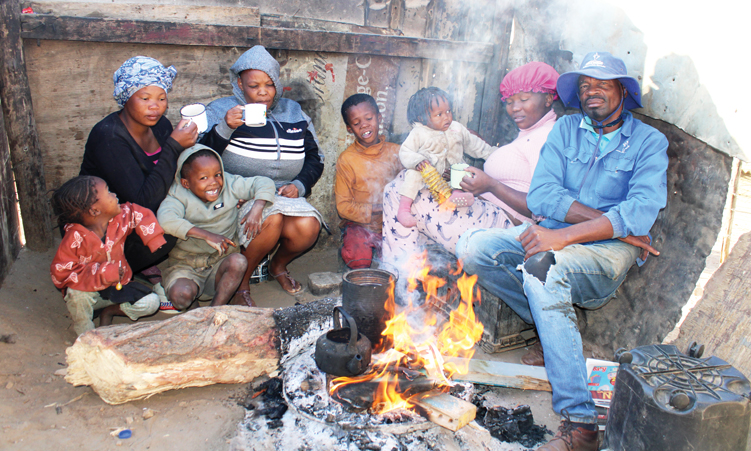
The location of Omakange across the Omusati and Kunene regions is stalling efforts to formally develop the settlement into a village council.
Ruacana constituency councillor Fabianus Paulus says part of Omakange falls under the Ruacana constituency in the Omusati region, while another part falls under the Opuwo Urban constituency in Kunene.
“Omakange is growing, but it’s difficult to develop it so it can have village council status, because it falls in two regions,” he says.
Paulus says the two regional councils must first reach an agreement on the appropriate region for the settlement before any progress can be made.
“If Omakange is to be developed further and elevated to a village council, the Omusati Regional Council and the Kunene Regional Council need to agree on where it should fall, because two regional councils cannot run one town,” he says.
Paulus says several public facilities already exist on both sides of the settlement.
On the Omusati side, Omakange has a high school, a kindergarten, a clinic, accommodation facilities, an agricultural extension office and the offices of the Uukwaluudhi Conservancy.
Meanwhile, the Kunene side has a police station, a fuel station and several shops.
Paulus says discussions between the two regional councils have already started.
Omakange is located on an important route linking Okahao, Kamanjab, Opuwo and Ruacana.
Its location across the boundaries of the Omusati and Kunene regions has often created administrative challenges and land ownership disputes involving the Uukwaluudhi and Otjikaoko traditional authorities.
Minister of urban and rural development James Sankwasa’s adviser, Boniface Mutumba, says any effort to establish a settlement area or village council at Omakange would require cooperation between the two regional councils.
He says both councils would need to jointly plan and approve the development process.
“This can only result from a joint planning committee established by these two regional councils and consented to by the minister in accordance with the Urban and Regional Planning Act 5 of 2018,” Mutumba says.
He says the two councils would first need to develop a harmonised spatial plan before submitting a formal application to the Ministry of Urban and Rural Development.
Regional councils are already required to prepare regional structure plans, and these plans would need to be aligned if Omakange is to become a formal township or village council, Mutumba says.
“To coordinate a joint application, the two regional councils will be required to establish a joint planning committee,” he says.
Mutumba says all land use plans, engineering reports, zoning proposals and settlement layouts would need to be prepared before an application can be submitted to the urban and regional planning board.
The board would then review the application and make recommendations to the minister for approval in line with the act.
“Should the minister approve the layout, the final land use rights, zoning schemes and township boundaries can later be promulgated in the Government Gazette,” he says.