THEY come in the sweltering September heat of the Zambezi sun. Men, women and children of all ages. They come in cars and on foot, while others are on bicycles.
Most are proudly clad in shirts and skirts that have the face of the Mafwe chief George Mamili the 7th. Some cars are draped with cloth carrying the chief’s face and the elephant, a symbol of power and endurance for the Mafwe people. The word Lusata runs across the breadth of the cloth.
As the crowds pour in at Chinchimane just outside Katima Mulilo on this Saturday morning, the master of ceremony, former University of Namibia professor Boniface Mutumba’s voice directs the people.
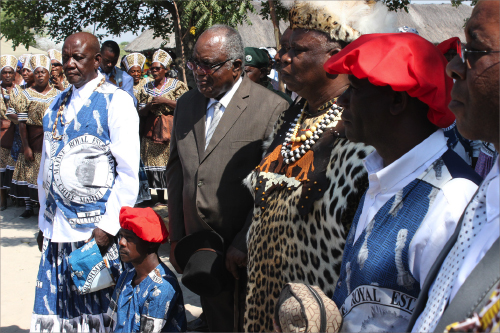
The respected elders sit in a thatched structure that stretches for about 10 metres. The chief has his own special bay on the farthest end close to where his wife and other notable women sit.
Reed mats are spread forming a perimeter for the chief and other respected elders to walk on. Women are not allowed to walk on the mats or worse straddle them lest their period flow will not stop until they are cleansed.
This year’s festival is a very special one because former president Hifikepunye Pohamba is the guest of honour. And Mutumba says most of the people have come because they heard about Pohamba’s presence.
“We are a very secretive community,” Mutumba says. “But I have to say this. Some years ago, an old woman came saying she did not want to vote for Swapo. She then asked if we can show her where to vote for Fikifiki (Hifikepunye Pohamba).”
And the crowd roars in laughter to this.
Today, however, this secretive community is baring its soul just as it has been baring its soul ever since the Lusata Cultural Festival was founded in 1981 by Richard Muhinda Mamili.
One feels it in the songs of joy. It is there in the dances that capture the Mafwe life from time immemorial. You feel it in the chanters’ voices that rise above the hum and din. Here the departed chiefs are exhorted not to forget the living while the current chief is politely advised not to betray the departed.
Pohamba aptly sums up the day: “We are here to express by deeds our culture through singing and dancing.”
Indeed the people sing and dance as they make history and plan the future while enjoying the present. All the three – past, present and future – are alive.
And Pohamba continues: “In many cases, history is about dead people. But Richard is here with us today. He has made history.”
This history, if one listens to the songs and observes the dances, appears to revolve around the chief. He is the unifying factor of all the 34 Mafwe communities that are divided by dialects.The centre that hold firm this tribe.
He is respected, feared and adored. The communities look up to him and as Mutumba puts it: “We do not need to elect him. He is chosen.”
While every song and dance is about the chief, he does not utter a single word throughout the proceedings.
Of course, he takes part in the processing when the festival is officially opened. Then he sits in his bay – alone and observing his subjects. The last thing he does is take a walk around the perimeter of the arena showing the mace. Even his speech is read for him by an adviser.
His words are few and measured. He talks about his people walking long distances to the nearest health facilities at Sibbinda and Katima Mulilo. He says elephants are destroying crops and government should do something about it. The elephants are too many, he opines.
The chief also touches on the issue of drought. His people need help. But he urges them to start small fruit and vegetable gardens. In the same breath, he castigates those who abuse children and women.
Ululations, songs and chants punctuate the chief’s message spoken through another man’s mouth. The chief does not show any emotions. He sits still. He does not look into his subjects’ eyes neither does he shake hands with anyone. Very few are allowed to go within a whispering distance of him.
It does not matter whether one is educated, or is a government minister. They all kneel before the chief. Politics does not hold sway here. Swapo and RDP leaders mix and mingle as one family.
The women apart from kneeling, clap their hands three times when the chief passes or when they are close to where the chief is. This respect and admiration comes clear when Mutumba whispers into the microphone: “I am not sure what I will do if the chief passes by here.”
When the chief takes the mace around, he is accompanied by a few advisers and the choir of women clad in orange outfits with a zebra design on the front. The chief is in leopard skins.
The choirs take turns to sing as the chief walks a few steps at a time while lifting the mace for the people to see. This mace, Mutumba says, is made of pure ivory. There is an elephant carved on top of the mace. It appears the Mafwe have an affinity for the elephant and the leopard. As the day wears on and the people sweat in the sun, the chief and the notable people depart for lunch, while entertainment continues. There are promises about the festival getting bigger next year with the invitation of traditional authorities across the country.
Hopefully, chief George Mamili the 7th will have company on an equal footing.
In an age of information overload, Sunrise is The Namibian’s morning briefing, delivered at 6h00 from Monday to Friday. It offers a curated rundown of the most important stories from the past 24 hours – occasionally with a light, witty touch. It’s an essential way to stay informed. Subscribe and join our newsletter community.

The Namibian uses AI tools to assist with improved quality, accuracy and efficiency, while maintaining editorial oversight and journalistic integrity.
Stay informed with The Namibian – your source for credible journalism. Get in-depth reporting and opinions for
only N$85 a month. Invest in journalism, invest in democracy –
Subscribe Now!