




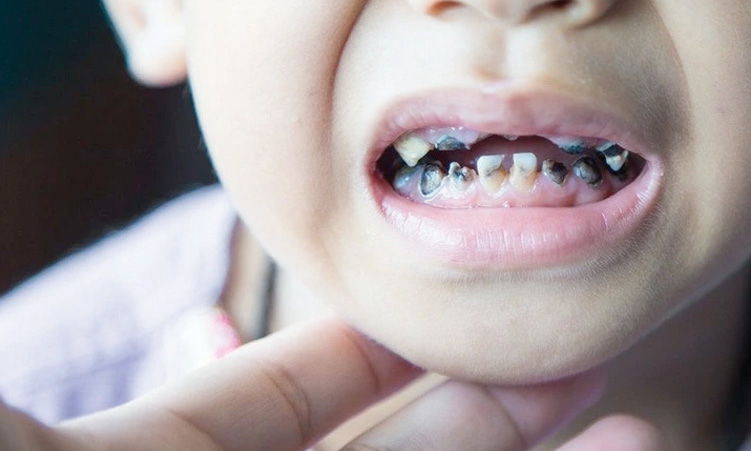
AN alarming number of toddlers end up in theatre for a procedure most parents never expect before their children start preschool – multiple tooth extractions.
The culprit? Iced tea, sweetened with sugar or honey and juice, and served daily to infants and toddlers across many Namibian homes.
In many households, especially where mothers return to work early or can’t afford formula, iced tea has become a popular go-to.
It’s believed to be soothing, affordable, and better than sugary juice.
However, it is often served sweetened and sometimes even fed through baby bottles – a dangerous habit, according to dental experts.
Children under the age of two, according to health practitioners, are developing severe tooth decay – a condition leading to painful infections, sleepless nights, and in many cases, high-risk theatre operations under general anaesthesia.
Health practitioners from Dr Kagiso Moloi and Associates say they have observed an increase in tooth decay among children, largely caused by sugar in tea and other sugary drinks.
“Over the years, we’ve noticed more tooth decay in children, not necessarily from rooibos tea, but mainly from sugary tea. Normal tea can be more harmful because it contains caffeine. The bigger problem, however, is sugar,” Dr Kagiso Moloi says.
He says the natural bacteria in the mouth feed on sugar and produce acid, which weakens the enamel.
“This leads to demineralisation and, eventually, decay. If a child visits the dentist early, the decay can be reversed with a filling.
But if it reaches the pulp, the child will experience pain, and the tooth may need to be removed. That’s why reducing sugar in drinks is crucial,” he said.
PAIN, DISTRESS
Moloi says dentists often opt for general anaesthesia because treating young children while awake can be distressing for both the child and the parent.
“It’s very uncomfortable for a dentist to perform procedures with a crying child or an anxious parent.
That’s why we sometimes choose general anaesthesia. Anaesthetists are well-trained professionals, and the risks are minimal. It’s very rare for children to suffer serious complications,” he says.
He urges parents to reduce their children’s sugar intake and ensure they maintain proper oral hygiene.
“Give children drinks with less sugar, encourage a balanced diet with fruits and vegetables, and ensure they brush their teeth after meals.
Parents should start taking their children to the dentist from as early as six months. Even milk teeth should be brushed using a soft-bristled brush and mild toothpaste. This helps prevent future dental issues,” he says.
‘ADDICTED’
Paulina Nakale, a mother of two, says her son (2) had to undergo a dental procedure under general anaesthesia after experiencing severe toothache.
“It was not a good experience. My child had four teeth removed and four others treated, which was really tough for him.
The problem started with the tea we mixed with juice. He became so addicted to it we couldn’t take it away. Sometimes he would even fall asleep with his bottle,” she says.
Nakale describes the experience of seeing her child go into theatre as one of the most difficult moments of her life.
“Watching him being put to sleep just so the dentist could remove his teeth was heartbreaking. He was in theatre for about 45 minutes. In that moment, your mind as a parent stops functioning properly – you just keep wondering whether your child will wake up,” she says.
MORE WATER,
LESS TEA
Nakale now advises other parents to give their children water instead of tea.
“Don’t give your children tea, no matter how cheap it is. Let them drink water from a young age, because those beautiful teeth will be damaged. It’s painful when children lose their front teeth – other children make fun of them and bully them,” she says.
Meanwhile, another parent, Jennifer Hoveka, says she had initially given her child various milk formulas without them affecting the child’s teeth.
“His teeth were fine while we were giving him different formulas. But once I switched to tea – mainly because formula is so expensive – that’s when the decay started,” she says.
Hoveka says although her child’s teeth are now falling out, they are unable to take him for removal because they do not belong to a medical aid scheme.
“We’ve tried to stop giving him tea, but he cries for it every day. It’s been difficult,” she says.
She urges other parents to avoid giving their young children tea.
“I want to advise parents to stay away from giving tea. It’s not worth your child’s teeth. At first, everything seemed fine, but later we realised the tea was the problem.”