



A SENIOR environment official says when communal farmers kill wild animals in retaliation for having lost livestock or crops, there is no real winner as the wild animal might be the same animal with a high tourism potential contributing to the increase in tourist activity in the country.
Marthin Kasaona, a chief conservation scientist in the ministry made these remarks at a Wildlife Conservation Forum side event at the just-ended 14th Convention on Biological Diversity, in the Egyptian coastal resort city of Sharm El-Sheikh.
The Namibian government, said Kasaona, is promoting the co-existence of humans and wildlife, and local communities that have registered communal conservancies have the right to manage and derive benefits from the natural resources.
Although the community-based conservation programme is heralded as the most successful model of community-based conservation in the world, the issue of human-wildlife conflict is a serious issue that needs to be tackled, he said.
“We should also recognise that the increase in human-wildlife conflict could be linked to an increase of wildlife populations due to better conservation programmes implemented in the country,” he said.
He said as a result of human-wildlife conflict, 545 head of cattle, 79 sheep, 291 goats and 15 donkeys were killed by problem wild animals in 2016.
Kasaona explained that the Namibian government will never sufficiently offset the price of livestock or damage to properties by problem animals, however, the recent adjustment to the compensation scheme amounts is much better than the previous amounts for each livestock killed.
Previously, compensation for sheep and goats was N$250 per animal killed, while for cattle it was N$1 500. This figure did not consider the average market price for cattle which was around N$6 000 per head.
Frustration over the meagre compensation may have inadvertently triggered the retaliatory killing of problem animals by the farmers.
Speaking at the same side event, deputy director in the department of wildlife and National Parks, Bennet Kahuure, said Namibia’s community-based natural resources management has had a number of achievements.
He said in 2016, communal conservancies generated over N$111 million in revenue.
Kahuure said through the ministry, 10 568 wild animals of 15 species where translocated from national parks to communal conservancies since 1998.
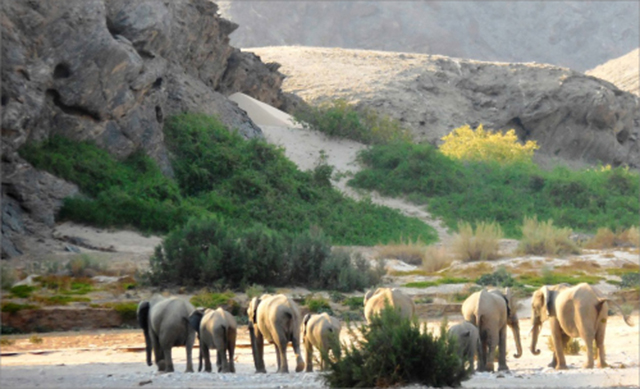
“Our desert lions have rebounded from near extinction to occupy an expanded range. Namibia has an increased free roaming lion population outside national parks. Our elephant population has more than doubled from 7 500 in 1995 to over 25 000 in 2017,” said Kahuure, adding that since independence, Namibia had also expanded its protected areas considerably.
Tjavarekua Tjijahura, the chairperson of the Women for Conservation Organisation in Kunene region, said the role of the organisation is to raise anti-poaching awareness in communal conservancies.
“We decided to start from home. We educate our people about the disadvantages of poaching,” said Tjijahura.