



RESIDENTS of Omafo in the Helao Nafidi district are up in arms over a rubbish dump they say has become a breeding ground for diseases.
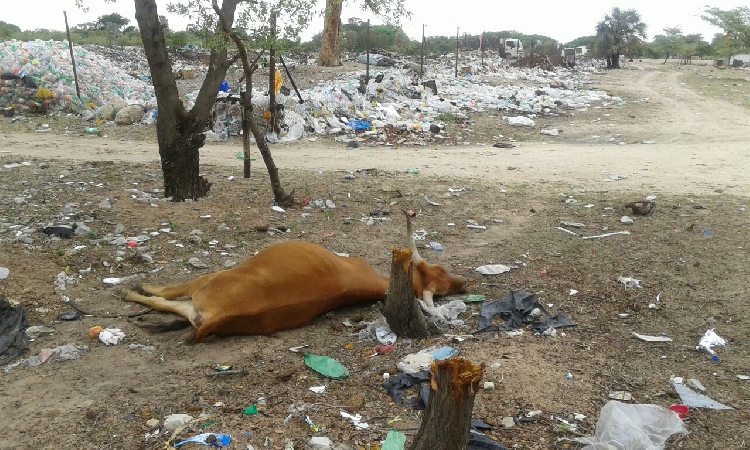
Some residents say the dumpsite, created in 2003, daily attracts area children and the poor who scavenge for expired food at the landfill.
“We do not understand why the Helao Nafidi Town Council does not want to look at the plight of the people living close to the dumpsite at Omafo,” said resident Christof Nekongo.
He said the town council did not consult residents when the landfill was created.
“In fact, they lied to the headman at the time, saying that a factory would be set up when they were clearing the land,” he claimed.
Nekongo added that due to the landfill’s proximity to the residential area, people now experience breathing problems because of the smoke.
“The whole village is now full of poisonous smoke from burning rubbish in the mornings and evenings,” he said.
On top of that, plastic bags and papers from the dumpsite are also scattered around the village.
“Our animals are dying on a daily basis due to the plastic bags they eat from the dumpsite, as it is not properly fenced off, and livestock roams freely inside,” he said.
Another resident, Vilho Andreas, also spat venom, saying the town council was gambling with people’s health.
“That landfill is in a residential area, set up without consultation, and our lives are now in danger.
“Children and the elderly are eating from it, and the Engela Hospital is dumping its waste there while the place is not well- protected,” he said.
Nekongo said the security company contracted to prevent people from entering the area was also not doing its work.
Residents have written letters to the town council, without receiving a satisfactory response to date.
“They only acknowledged receiving one letter, and then they went mum,” he said.
Both Andreas and Nekongo called for the closure of the dumpsite.
Helao Nafidi mayor Eliaser Nghipangelwa said the dumpsite and concerns over have been well-documented.
He said a remote area has been identified to which to relocate the dumpsite, but some people had rejected the relocation.
“We once found a new location close to an oshana, but some people said this could contaminate water. Others refused to have a landfill in their village,” he said yesterday.
Nghipangelwa could not say whether people were consulted before the dumpsite was created.
“I was not in council that time,” he said.
Nghipangelwa said a South African company had been engaged to collect garbage and to recycle it at a plant planned for Oshakati.
“However, this could take time and money, and I do not want to say much about it. Money is scarce everywhere, just like at our houses,” he said.