





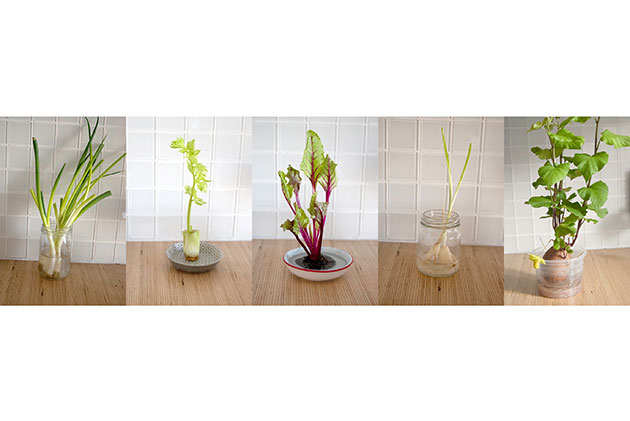
I love fresh fruit and vegetables. Whether I source them from the organic biomarket each Saturday, scope out different supermarkets for the best deals, or buy from a street vendor, eating fresh produce is the kindest thing I can do for my body.
I often marvel at how farmers are able to effectively grow their own food. The idea of doing so myself seems daunting and near impossible. After much research and experimentation though, I’ve found ways to grow little greens – all from the comfort of my own kitchen.
I believe being able to grow some of our own food is not only an important survival skill, but also helps you appreciate the food you eat that much more.
Save the seeds any time you eat fresh fruit or vegetables. Remove any excess flesh and leave them to dry out in the sun for a day or two before you attempt the germination process.
Some seeds are harder to germinate than others, and some prefer direct to partial sunlight, so do your research to find out what works best for whichever plant you’re trying to grow.
I’m sure you all remember the experiments you did in primary school when you had to bring a bean to class and grow it in a jar. The principle hasn’t changed. Simply place a few beans in a glass or plastic container, place a little cotton wool, a paper towel or paper on top of the beans, then spritz with water. After a few days roots will start to form and the sprouts can be transferred to soil.
Next time you head to the supermarket, grab a bunch of spring onions for planting.
Don’t throw away the roots and leave at least five centimetres above the roots before placing the bulbs into a glass jar with about one centimetre of water.
After a few days, the leafy ends of the onion will start to regrow, and you can snip off the onions and use them in your salads, soups or other dishes. You can either choose to keep it in water for a while (make sure to change the water daily) or you can transfer the spring onions to the soil once longer roots have started to form.
Similar to spring onion, garlic, lettuce, celery and bok choy can be regrown in water. After cooking with the vegetable, make sure to leave about five to seven centimetres of the stem and place in a shallow container of water. After a few days, leaves will start to form and you can place it in soil.
Growing your own sweet potatoes isn’t as complicated as you think. One mature sweet potato can yield around 10 new sweet potatoes from its slips, which are the shoots that are grown from a mature sweet potato.
Grab a sweet potato and pierce it with four toothpicks facing outwards horizontally. Place the sweet potato in a container with shallow water using the toothpicks to make sure it isn’t fully emerged in water, and that the root of the potato is in the water.
Place it on your window sill or a place where it gets plenty of light, but not direct sunlight. After a few days the root will develop and in a week or two, shoots or slips will form at the top of the sweet potato.
Once the slips are long enough, gently pull them off the potato and place them in shallow water until roots start to form.
Once the roots are about an inch long, transfer it to loose well-draining soil and plant the slip about 10 cm deep with the root in the ground and the majority of the leaf outside. Your potatoes will be ready for harvest three to four months after planting them, but be sure to water them consistently.
Choose good potting soil with good drainage.
Direct sunlight may be too harsh for the plants in the beginning, but not enough sunlight will inhibit it from growing. Usually placing them in a well-lit room, away from direct sunlight, is the way to go.
While potatoes tend to be hardy and can grow in almost all seasons, cold winter frost may inhibit other produce if it’s grown outside. Try to keep your produce indoors if possible and plant them outside a few weeks before spring when the worst of winter is over.
Harvest time depends on what you are growing and what the conditions are. Cucumbers and beets take 50 to 60 days. Carrots and broccoli take 60 to 80 days. Lettuce and tomatoes can take from 50 to 90 days.
Ultimately, there are countless ways to grow your own food in your kitchen, and there are countless resources available for free online.
You won’t regret taking the time to learn more about the food you eat as an investment in your health and in sustainability.