




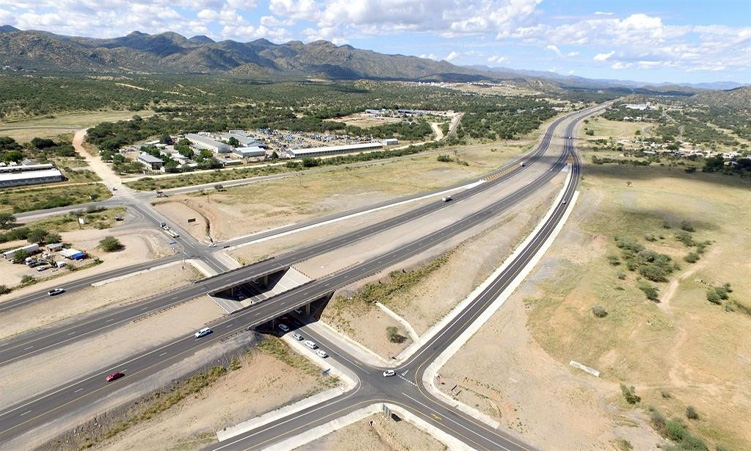
The Ministry of Works and Transport plans to construct dual-carriageway freeways across Namibia to reduce road accidents and improve transport efficiency and economic activity.
The government plans to construct the Usakos-Arandis dual-carriageway this year as part of broader efforts to improve road safety on high-risk routes.
This road has proven to be one of the most accident-prone roads in the country.
Works and transport minister Veikko Nekundi yesterday confirmed the initiative, saying the ministry is prioritising key roads with heavy traffic volumes and accident records.
“We will start with Usakos-Arandis this year. In addition to Windhoek-Okahandja, we are equally busy with Swakopmund and Walvis Bay,” he said.
Last month, Nekundi announced that the government allocated about N$200 million towards road safety initiatives in the 2026/27 financial year.
The amount excludes infrastructure spending managed separately by the Roads Authority and will cover enforcement technology, awareness campaigns and road safety audits.
The Motor Vehicle Accident Fund newsletter, issued on 30 April, says Namibia recorded 921 crashes, 1 467 injuries and 143 deaths between 1 January and 26 April this year.
The fund says about 72% of crashes are caused by human error, including speeding, driver fatigue, distracted driving and overloading.
Between January and October 2025, the country recorded more than 2 600 crashes, 414 deaths and thousands of injuries.
Former Roads Authority chief executive Conrad Lutombi says during his tenure that ended last year, he advocated a dual-carriageway freeway stretching from Okahandja to Otjiwarongo up to Omuthiya because of the heavy traffic along the corridor.
Referring to the multi-billion-dollar Windhoek-Okahandja freeway project, constructed in phases between 2014 and 2024, Lutombi says he does not recall any fatal accidents reported since the dual-carriageway became operational.
“Any effort by a country to save lives is an effort worth investing in. I am critically advocating freeways to extensively cover Otjiwarongo, Okahandja and Otavi up until Omuthiya, because these are busy roads and many lives have been lost on these roads,” he says.
Independent Patriots for Change shadow minister of works and transport Nelson Kalangula says he has raised questions in parliament regarding the pace of road upgrades, design processes and construction timelines on major highways.
Kalangula says roads such as the Usakos-Arandis-Swakopmund route and the Okahandja-Otjiwarongo-Otavi corridor require urgent upgrades to either dual-carriageway or 2+1 roads, especially because they are often used by trucks.
“These are areas of high accident risk, and dual-carriageways or 2+1 roads can save lives. An example can be seen with how the upgrade of the Windhoek-Okahandja dual-carriageway reduced accidents by a large margin,” he says.
Meanwhile, member of parliament George !Garab tabled a motion in the National Council calling for urgent measures to address the escalating road accident figures.
“The continued rise in fatalities and serious injuries on Namibia’s roads have reached intolerable and unacceptable proportions,” !Garab says.
Roads Authority council board chairperson Amalia Gawanas says the National Road Safety Council (NRSC), together with stakeholders under the Second Namibian Chapter of the Decade of Action for Road Safety 2021-2030, has secured N$10 million for the police to strengthen traffic law enforcement.
The funding will assist in procuring vehicles and equipment for enforcement operations along key B1 and B2 highway sections.
Gawanas says the NRSC has also started deploying intelligent transport system cameras at accident hotspots.
She says a pilot project between Usakos, Arandis and Swakopmund, implemented through the Arandis Emergency Response and Traffic Management Centre, has already shown positive results.
Preliminary findings from the pilot project indicate an 83% decline in fatalities within the monitored area.