


THE government is hoping investors in state debt would postpone demanding cash on two maturing government bonds with an outstanding balance of N$3,7 billion.
This would provide treasury with some temporary breathing space, but is set to become a burden later.
The Bank of Namibia, as the custodian of state debt, with the release of the current fiscal year’s borrowing strategy said it would give investors in the GC21 and GC22 government bonds, which are maturing next year and in 2022, a chance to liquidate their position or switch to a long-dated financial product.
According to the 2020/21 Government Borrowing Strategy, the next switch auction for the GC21 is scheduled for 5 August this year.
The switch auction is a platform where investors in a certain bond which is about to mature can choose to either receive the principal investment they lent the government or to invest in another bond.
This means instead of investors receiving their money, they choose to lend it back to the government at a periodic return in a different bond.
The switch auction is always held before a bond or treasury bill reaches its maturity date.
The GC21 bond will mature next year on 21 October, and the government is expected to pay back the outstanding amount of N$934,2 million they borrowed.
Investors will decide at the auction whether they want to be repaid or whether to roll it over to another bond.
Switching bonds would allow the government to not redeem a whole outstanding amount on maturing bonds.
It will also aid the funding of the current budget deficit, as most of the long-term investors, such as pensioners, would switch to long-term securities to match their investment strategies.
In addition to the GC21 switch, the government will also hold a switch auction for the GC22 during the second half of the fiscal year.
The GC22 matures on 15 January 2022 and has an outstanding balance of N$2,8 billion, which will be repaid to investors or lent back to the government to fund the current budget shortfall of N$21,4 billion through long-dated bonds.
The government’s borrowing strategy for the current financial year shows they will borrow N$10,4 billion of the N$21,4 billion from the domestic market.
This puts the government head to head with the private sector, and state-owned entities such as the development and agricultural banks seeking funds, with the Ministry of Finance promising the private sector a guarantee to the tune of N$2,3 billion.
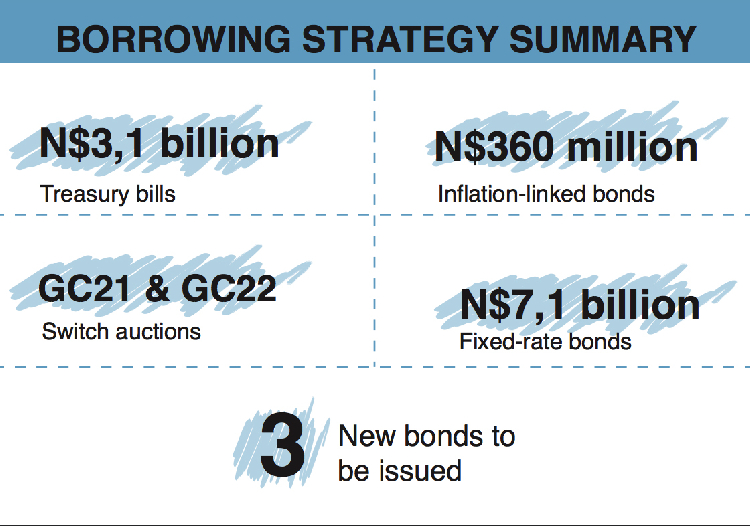
The borrowing plan indicates that N$3,1 billion of the N$10,4 billion will be borrowed through treasury bills, representing 30% of the domestic borrowing requirement.
The plan also indicates the government will only borrow N$360 million through inflation-linked bonds.
Inflation-linked bond auctions will commence in August 2020 as per the revised issuance calendar.
The balance of N$7,1 billion will be borrowed from various fixed-rate bonds.
In addition, investors will be given the opportunity to invest in the GC22, GC24, and GC25, which are currently not available on the open market, but will be reopened during the July bond auction.
The FY2020/21 borrowing plan introduces a new fixed-rate bond, the GC26, which will be issued on 22 July, and will mature on 15 April 2026.
The current deficit will be funded domestically through 10 active plain vanilla bonds, coupled with the three inflation-linked bonds and treasury bills.
According to the central bank, this is “enough to sustain the funding activities in the primary domestic market, while providing investors with diverse investment instruments”.
The national budget deficit increased exponentially during FY2020/21, with the borrowing strategy attributing this to the Covid-19 pandemic and the ensuing economic shocks from the instituted containment measures.
The government’s total expenditure increased by 7,1% from the previous year, while revenue is projected to fall some 11,8%.
Similarly, as a ratio of gross domestic product (GDP), the deficit increased 2,5 times from 4,9% to 12,5%, with the stock of public debt projected to increase from 50,7% of GDP to 68,7% after the planned borrowing.
This is close to double the self-imposed debt threshold of 35% of the treasury.
Email: erastus@namibian.com.na