



BRYAN O’Linn was truly a giant among his peers on the Namibian legal scene.
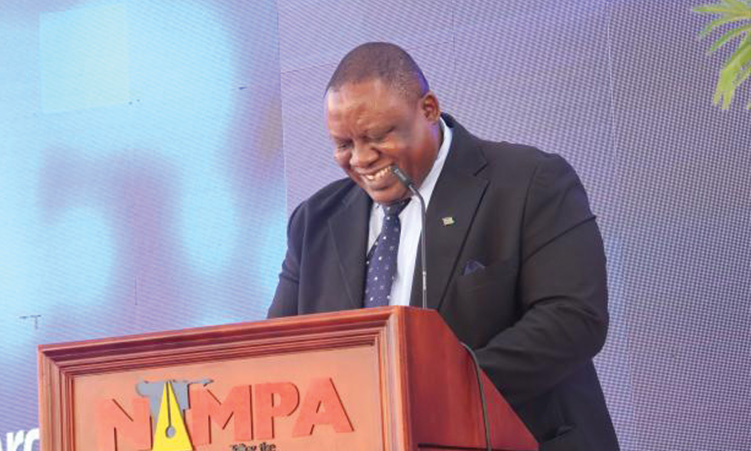
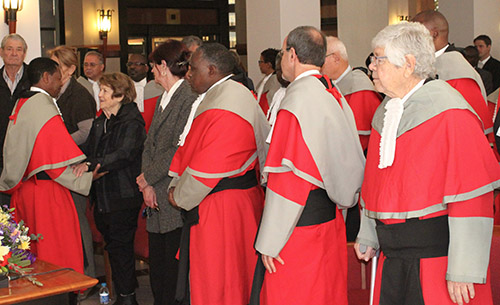
This statement was part of the tribute that Chief Justice Peter Shivute paid to the late Judge O’Linn at the Supreme Court in Windhoek yesterday.
Addressing an audience that included O’Linn’s widow, Miemie, judges of the Supreme Court and High Court, and members of the legal profession, Chief Justice Shivute remembered O’Linn, who died at the age of 87 last weekend, as a man of integrity, upright principle, hard work and tenacity.
As a lawyer and chairperson of the Society of Advocates through most of the 1980s, O’Linn spoke out strongly against the abuse of human rights and in favour of a constitution protecting human rights and the rule of law, the Chief Justice said. As a judge – first in the High Court for about nine years, and then in the Supreme Court for seven years – O’Linn contributed generously to the jurisprudence of Namibia, in the form of many landmark judgments that he wrote or was involved in, Chief Justice Shivute added.
He further recalled that O’Linn “orchestrated, steered and veered our criminal jurisprudence in a direction which has brought to the fore the constitutional rights not only of accused persons but also the interests of victims of crime”. O’Linn’s words would live on among the many pages of his judgments, on wide-ranging subject matters, which would continue to guide Namibia’s courts, the Chief Justice said.
A friend and colleague of O’Linn in the legal profession, Peter Koep, paid tribute to him as someone who “should be recognised as a patriot and Namibian hero”.
That, Koep said, was because O’Linn “not only dreamed of a free and independent Namibia, but acted in terms of his convictions, demonstrating courage and foresight, providing direction and offering courage to his fellow Namibians to accept Namibia’s independence”.
Said Koep: “Bryan fought for the freedom of this country long before it became fashionable to do so. Instead of using a conventional weapon he used his intellect, his commitment to this country and the power of his word. For this he deserves to be recognised.”
Chief Justice Shivute also recalled the role that O’Linn played as defence counsel for numerous people who were criminally charged over the role they had played in Namibia’s liberation struggle. O’Linn “was one of the brave lawyers who took a principled position to represent freedom fighters charged by the apartheid state for their political activity at the time when such a course was not fashionable or popular and the risk of being ostracised form the community loomed large,” the Chief Justice said.
Koep remarked: “Bryan believed that the law was an instrument for effecting justice, that it should be accessible to everyone, that no one was above it and that lawyers were or should be engaged in a continuous fight for equity. In line with those beliefs, Bryan was committed to making South West Africa a better and fairer place to live in. For this reason, support for Namibian freedom and self-determination was a primary objective throughout his life.”
Except for being a prominent lawyer, O’Linn was a leading figure in the opposition United Party of SWA, and later led that party’s successor, the Federal Party, which in its time was one of the most liberal parties on the country’s political scene.
Although his progressive political stance exposed him to racist accusations and antagonism from fellow white people, O’Linn stuck to his ideals to the end, Koep said – and ultimately he was vindicated when Namibia became independent in March 1990.