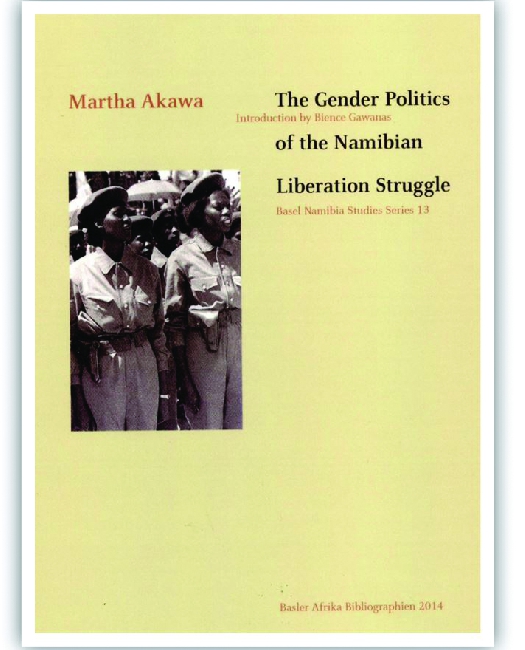
•Henning MelberThis monograph on the ‘The Gender Politics of the Namibian Liberation Struggle’, was originally submitted as a dissertation to the philosophical faculty of the University of Basel in 2009.
It fills an important gap in literature on Namibia by summarising the results of interviews conducted among Namibian women involved in the struggle for Independence. They share their experiences and insights concerning their life in exile and in particular the refugee camps in Zambia and Angola.
The frank conversations include issues hitherto largely treated as taboos and not often – if at all – a subject in the public domain.
Their voices place the heroic narratives of the official patriotic history in a different perspective and add a so far largely undisclosed gendered perspective. The accounts contrast with the romanticised political propaganda of an emancipated female heroism carrying the torch of the anti-colonial struggle, as at times illustrated in the documented posters and pamphlets of the national liberation movement Swapo, in chapter 1. This chapter also includes tributes by portraying the few popular and well-known female protagonists that gave the struggle a gendered face. But the majority of women remained faceless and played second fiddle in supportive acts.
The accounts offer insights into the often-harsh conditions to which women were exposed in the refugee camps (chapter 3). Notwithstanding such realities, some reminiscences of “good old days” surfaced in the memories. As Akawa notes: “Listening to the hardships and some gruesome stories about the camps, I was surprised to hear that some respondents today miss the exile camp. … Some even wished to live that life again.” (p 119) As she explains, the camps were, despite all suffering, also a safe haven providing a spirit of comradeship, sisterhood and togetherness. Swapo was the family providing the means for survival and basic protection. But, as is also mentioned, this setting also promoted a mentality of dependency.
The promiscuity that characterised the sexual behaviour as part of the lives in camps and exile at the same time offered to women the relative freedom beyond traditions at home to have pre-marital sex, out-of-wedlock children and children from different fathers, which like “other issues concerning sexuality were not viewed with shame and disgrace in exile. However, these issues were heavily stigmatised in communities inside Namibia and are still stigmatised in post-independent Namibia.” (p 121) In contrast to the relative liberties in a foreign environment, back home, after independence, the perception exists “that women who were in exile did not fight the enemy, they only fought iota yongali” (p 123) – which translates into “war lying on one’s back facing up”, implying that women had sex rather than engaging in the anti-colonial struggle by other means and in other forms while abroad.
The role of women in satisfying sexual desires was indeed a substantial and prominent feature in the camps as the interviews reveal (chapter 4).
These physical interactions with men were far from always based on consent. Women and girls were often considered as mere objects and the property of the male fighters. Higher-ranking officials in the movement seemed at times to abuse their authority to demand sexual favours. Complaints (if launched at all) were often ignored or ended in the male camp administration without any consequences. As a respondent stated: “The main aim was to fight for independence, other things were secondary” (p 147).
As a result, rape and other forms of sexual abuse were often taken for granted as a common feature of camp life and a sacrifice, if not service, women had to provide.
At the same time, Namibian women were considered as Namibian property only. While men were allowed to enter into relations with women from the neighbourhood, “when women were caught or alleged to be dating foreign men, they could be in big trouble. It was a transgression and severely punishable. … allowing only men to marry foreign nationals and not allowing women to date foreign men or subjecting them to punishment, amounted to total control of female sexuality.” (p 144)
In a thoughtful epilogue (pp 195-198), Akawa summarises the contradictions and double standards to which women were exposed in exile, as well as independent Namibia, with regard to the limits of their liberation and the gendered bias they experienced and still experience in their daily life. The book adds credible new evidence and insight to what so far has largely been described partly in so-called ‘dissident literature’, which criticises Swapo for its repressive structures in exile from the perspectives of those who were treated as traitors. See the latest sobering account in Samson Ndeikwila’s ‘The Agony of Truth’. It thereby provides additional credibility to the critical assessments concerning the narrow limitations of the emancipatory project.
The author, now heading the Department of Geography, History and Environmental Studies at the University of Namibia in Windhoek, concludes that since Independence “the pretentious pronouncements of gender equality have not been translated into the effective implementation of radical measures to effect gender equality and equity” (p 194).
The extent to which this might change through the implementation of a Swapo decision on ‘zebra lists’ – to have a 50% female representation in parliament – remains to be seen.
At least, one might argue, after 25 years the contribution by women to the liberation struggle and nation building finds a somewhat adequate formal recognition. But in the light of the ongoing gendered violence of shocking dimensions and brutality, where the horrific abuse of girls and women remains a daily occurrence, the author has reasons to diagnose: “Even 20 years after the end of the war, women’s bodies remain battlefields.” (p 28)